





|
November 18, 2010
Sunset Commission
Staff TxDOT Recommendations (PDF)
September 27, 2010
Update
TPC Approves for Public
Comment Downward Revised RTP
The Transportation Policy Council approved
for comment a sharply curtailed Regional Transportation Plan with an
expected $23.3 billion future funding shortfall from the State of Texas.
Read the summary comparison of the original to the
revised plan here
(PDF).
August 23, 2010
Texas Can Meet the
Challenge to Transportation Funding
Houston is
in an unprecedented vacuum of state highway funding. At the current
funding levels, Houston will receive only $60 million per year for next 10
years for new capacity improvements in the region. This compares with
averages of $653 million per year beginning in 2001.
As a result, major highway improvements will have to be significantly
delayed or cancelled and the public will continue to experience growing
congestion on area freeways.
Against this backdrop, the West Houston Association Board of Directors
calls upon the State Legislature to enact motor fuel tax and registration
fee increases at the state and local levels in order to return Houston’s
roadway construction and maintenance program to levels that will allow
projects to move forward and not be cut from the regional plan as is being
contemplated. The West Houston Association position statement below
outlines the issue, its history and options to help solve this crisis.
(Download PDF File)
Position Statement on Funding Increases
The West Houston Association supports action by the
82nd Texas Legislature to increase transportation revenue in
order to assure the Houston Metro Area a minimum of $1.2 billion per year
in new roadway and maintenance contract letting authority, the annual
amount of state and federal funds needed to assure funding of programmed
projects in the 2011-2014 Houston Metro Area Regional Transportation
Improvement Plan[i].
Although this plan does not sufficiently address all the roadway
construction needs of the region, it is a minimal acceptable level given
the current congestion levels and population and employment growth of the
Houston area.
To achieve $1.2 billion for Houston area projects the West Houston
Association endorses any sufficient combination of statewide and local
option motor fuel tax increase with indexing and vehicle registration fee
increase.
Rationale
The Houston Metro Area will have $867 million per year less funding for
roadway expansion and maintenance projects between 2011-2014 according to
the current draft of the region’s Transportation Improvement Plan (TIP).
This translates into removal of needed projects from the TIP. If the
current revenue forecast by TxDOT is not reversed, the Houston Metro area
is projected to lose $37 billion through 2035 in state and federal
transportation funding. .
This West Houston Association position recommends closing the gap in the
Houston Metro area transportation plan by implementing any one or
combination of increased existing and additional fees. These fees can be
a mix on statewide and local option fees. The Association believes all
are acceptable individually or in some combination sufficient to achieve
the goal of providing a minimum total of $1.2 billion per year to the
Houston region. This level of contract letting will be consistent with
the currently approved regional transportation plan.
Following are potential measures for increasing
Houston transportation funding[ii]
(Houston allocations are set at 19% of the statewide totals):
1.
Increase State Motor Fuel Tax from 20¢ per gallon
a.
Each 1¢ increase statewide nets an additional $111 million annually
in transportation funding with a potential gain to the Houston area of $21
to 23 million. 75% of gross revenue goes to transportation; 25% of gross
to public education.
b.
A 5¢ per gallon increase statewide would result in an additional
$560 million per year with a Houston area gain of $105 to 115 million per
year.
c.
A 10¢ per gallon local option motor fuel tax would result in $245 million per
year in revenue in the 8 county TxDOT Houston District area—this
calculation is based upon the district’s share of state vehicle
registrations.
d.
Motor fuel consumption is on the decline and will eventually need to be
substituted with an alternate means of capturing equivalent revenue, such
as with a vehicle mileage fee. However this could take years and many
legislative sessions to refine.
2.
Indexing the Motor Fuel Tax—inflation
has and will continue to erode the value of the 20¢ state motor fuel tax.
Indexing the fuel sales to inflation of 3% would accrue $395 million more
statewide annually. Houston’s share would be approximately $79 million
annually.
3.
End Non-Education State Highway Fund Diversions—non-education
diversions of the state motor fuel tax total $766 million per year in 2008
and 2009. For 2010 and 2011 the diversions amount to $575 million per
year with DPS being by far the largest at $562 million per year. If these
diversions stop, funds would be returned to highway construction and
maintenance. For the Houston area this would mean approximately an
additional $110 million per year.
4.
Increase Vehicle Registration Fees
a.
A $25 increase in the average vehicle registration fee would generate $600
million annually with the Houston area realizing an additional $114
million annually.
b.
A $25.00 local registration fee applied in the Houston District would
yield approximately $111 million annually. (with registrations in district
of 4.47 million in 2008)
Background
The TxDOT funding crisis has been building for years. Major construction
projects such as Interstate 10 West and the sale of general revenue and
highway fund backed bonds only masked the underlying problem of an
unsustainable funding model. These factors are affecting funding at the
state level:
-
Greater demand from
increasing population and travel—in 25 years, Texas population
increased 53%; vehicle miles of travel 103%. Future projections are for
27% greater population and 67% increase in vehicle miles. New roadway
capacity over the last 10 years has increased only 10.6%.
-
Falling revenue
from traditional user fees as fuel efficiency increases—FY 2009 state
motor fuel tax revenues declined 2.17% from FY 2008. FY 2010 revenue
through January is off 1.25%. The prior two years showed 2% and 1.7%
increase in fuel tax revenues.
Future vehicle fleet fuel efficiency will yield greater miles per gallon
of fuel. New federal fuel standards require car-makers’ fleets to reach
a 35.5 per gallon average by 2016, 14 years sooner than previously
required. This will contribute to accelerated deterioration of fixed
rate motor fuel tax revenue.
-
State
Transportation Debt financing totals $11.5 billion—as project costs rose and with
limited cash flow from tax revenue, the state has turned to debt
financing. In 2009 TxDOT bond revenue/interest amounted to 19% of its
total revenue.
$3.1 billion in highway fund revenue bonds (with debt retired by
State Highway Fund 6 revenue) have been issued by TxDOT with another
$1.5 billion issued in July, 2010 and $1.4 billion issued in late 2011.
The debt service on these bonds will reach nearly $500 million each year
through 2026 and decline for 5 years until paid off.
The Texas Mobility Fund (TMF), authorized by voters in 2001 has resulted
in the issue of another $6.3 billion in bonds. In 2003 the
legislature identified revenue from certain transportation related fees
to be used to pay the debt service on these bonds. The Comptroller
certifies the amount of bonding authority based upon the requirement
that projected revenue from these fees be 110% of debt service. Debt
service for TMF is currently $300 million per year and will increase
yearly before reaching $500 million in 2039.
Another $5 billion in bonds were approved by voters in 2007. These
so-called Proposition 12 Bonds are general revenue obligations of the
state. They are not retired from revenue otherwise constitutionally
dedicated to transportation. The legislature subsequently authorized $2.1
million in bonds. The proceeds allow $1.85 billion for
construction in 2010 and 2011. TxDOT has developed an alternate letting
scenario forecast for 2012 and 2013 funded by an additional $1.6 billion
in Prop 12 funds.
-
Uncertainty of
Federal Highway Trust Fund—the
federal government, from whom Texas received $2.7 billion in 2009 or 39%
of the State Highway Fund revenue, is increasingly rescinding previously
approved funding appropriations and obligation authority. In 2008 TxDOT
was hit with a $258 million rescission. In Sept 2009 TxDOT was hit with
another $742 million rescission. Each results in delayed contract
letting and an inability to plan.
In addition, the federal transportation authorization bill has expired.
To keep the funding pipeline open, the federal government has resorted
to a series of “continuing resolutions” some lasting only 30 days. The
current one is an 8 month continuing resolution.
Recent federal stimulus funding has allowed approximately $2 billion in
projects to be scheduled for construction in 2009 and 2010.
-
Long term construction cost
increases—Texas
construction inflation increased 65% from 2002 to 2008 while decreasing
12% since the national economic downturn.
[iii]
IMPACT ON THE
HOUSTON AREA
The result of TxDOT funding crisis is hitting Houston and other areas of
the state. The multi-year regional transportation plan for the Houston
area is a compendium of street, highway and transit projects planned by
each local, state and federal agency. It is predicated on available
funding through 2035. TxDOT recently reduced its estimates of available
funds and resulting contract lettings in the Houston area through 2020 by
62% from $11.7 billion to $4.4 billion, a shortfall of $7.3 billion.
The regional plan cannot contain any projects for which there is not a
reasonable chance of funds being available. Because of this uncertainty,
the following chart shows the restrictions in available funds for Houston
areas projects compared to the previous 3 year period.
|
FY 2011-2014 Houston Region Transportation Improvement Plan
Financial Plan
($Billions) |
|
Project Type |
TIP 2008-2011 |
TIP 2011-2014 |
$ Change |
% Change |
|
Roadways (Federal-Aid) |
3.6 |
1.0 |
-2.6 |
-64% |
|
Roadways (Local & Toll) |
5.2 |
4.4 |
-.8 |
-15% |
|
Transit (Federal Aid) |
1.3 |
3.0 |
+2.3 |
+131% |
|
Transit (Local) |
1.2 |
1.7 |
+.5 |
+42% |
|
Totals |
$11.3 |
$10.1 |
-1.2 |
-11% |
[i]
$1.2 billion per year or total of $3.6 billion for 2011-2014
Transportation Improvement Plan is the amount funded in the 2008-2011
TIP and formed the basis of the projections over the following 3
years.
[ii]
TxDOT Financial Outlook, HGAC, April 2010
[iii]
Testimony of Texas Transportation Commission Chair Delisi before
February 1, 2010 Combined Texas House and Senate Transportation
Committees.
June 15, 2010
Texas Transportation Funding Crisis: A
Summary of Presentations to WHA's Issues Forum Panel on Transportation
Funding
Transportation funding is in
crisis—congestion is on the rise; revenue shortfalls are
relegating TxDOT to a highway maintenance organization; and badly needed
transportation projects are being eliminated from Houston long range plans.
To help focus the community on possible solutions to this crisis, the West
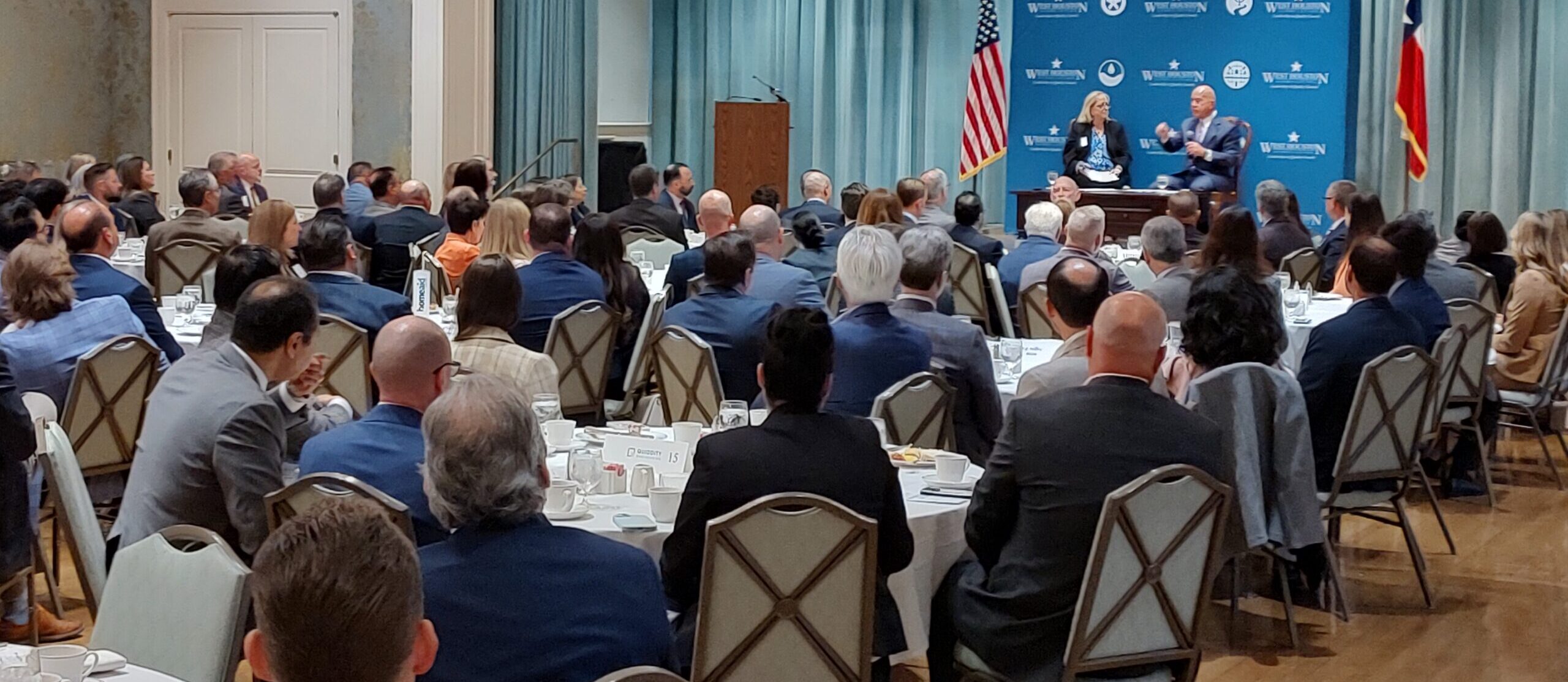
Houston Association hosted a timely Transportation Issues Forum featuring a
panel of:
• State Senator Glenn Hegar,
• Harris County Judge Ed Emmett and
• Texas Transportation Commissioner Ned Holmes.
Association Board member Joe B. Allen of Allen Boone Humphries Robinson LLP
acted as moderator.
Senator Hegar said he believed the Texas Legislature would not act to
increase the motor fuels tax or other related fees in the next legislative
session. He cited the shortfall in the state budget, projected to be as much
as $18 billion, and other legislative priorities such as redistricting and
public education. On the matter of local option fees it will be a hard sell
to members. He mentioned that in previous sessions that addressed local
options, legislators have been asked to vote for taxing authority without
getting of the benefit because their districts lay outside metropolitan
areas.
Overall, the Trans-Texas
Corridor project “poisoned the well” among the public and the Legislature.
Although attitudes are improving, TxDOT has a long way to go to restore
confidence. As a result of the soured attitude, further public-private
partnerships, a hallmark of the Trans-Texas Corridor effort, will be allowed
only on a “case by case” basis
On TxDOT Sunset, the Senator
discussed the current management audit and its recommendations which if
implemented would affect many of the items cited by the Sunset Commission in
its last evaluation of Transportation Department. Because of this the
Senator as chairman of the Sunset Advisory Committee will wait until late
2010 to schedule additional Sunset hearings on TxDOT.
Judge Ed Emmett discussed Harris County’s toll road projects—completing
Beltway 8 East and the Hardy Toll Road Connector to the CBD—which are state
highway projects over which the county exercised primacy with the intent of
completing expansion via toll financing. He also said the county was
progressing on design of Grand Parkway Segments F1 & F2. However other
projects—SH 288, Hempstead Toll Road—are advancing more slowly. Judge Emmett
said that progress on these projects would require a form of public-private
partnership.
The Judge said the US 290/Hempstead Tollroad is a very complex project. The
Hempstead Tollroad is an extremely costly project and the reduced congestion
benefit for the corridor would be more inexpensively achieved by providing
relievers to US 290 such as Segment E of the Grand Parkway and the 290
Commuter Rail. Judge Emmett added that the county was willing to
consider giving up primacy on the Hempstead Toll Road (and possibly others)
particularly if there is a commitment to use local engineers and
contractors.
Transportation Commissioner Ned Holmes acknowledged the problems caused by
the Trans-Texas Corridor program. He said that project was devised as a new
way of developing transportation projects for the future of Texas. It did
have problems and poisoned the relationship between TxDOT, the public and
the Legislature. However, he said that program was initiated by the
Transportation Commission and that they deserved the blame for its failures,
not TxDOT staff.
Commissioner Holmes stated that the current TxDOT funding forecasts and
state allocations result in the Houston District scheduled to receive new
capacity project funding of only $589 million for 10 years, or about $60
million per year. This contrasts sharply with the recent years when the
Houston District had annual funding well over $800 million for ‘03, ‘04 and
‘05 and averaged $653 million from 2001 to 2010.
The Commissioner added that to overcome this crisis will require a new
funding formula and new, stable sources of revenue. We will overcome the
challenge but “when” is the question? We are in real trouble and the
business community will need to help give the Legislature “political cover”
to step up and make the votes needed to overcome the funding problems.
March 2, 2010
"The Landscape Has Changed; Revenue is in Freefall"
Summary of Comments of Delvin Dennis, TxDOT Houston District Engineer
October 28,
2009 marked the first anniversary of the ribbon cutting of Interstate 10
West, a unique urban freeway reconstruction project: 21 urban miles,
$2.6 billion total cost and a record-breaking 6 years of construction.
It has positively affected commute times and development in West Houston.
However, the
financial landscape for TxDOT has changed for the worse and revenue is in
freefall. The independent panel assembled by the Transportation
Commission assessed annual statewide
needs at $14 billion per year while only $2 to $3 billion is available for
construction and design lettings. (The Executive Summary & Full Report of the 2030 Committee is available at
this link to the committee's website. (pdf))
The summary of needs is on a nearby chart. In 2010, TxDOT is
planning a construction letting of about $2.1 billion statewide (2010
obligation limit). Houston's share is $266.9 million plus $145.3
million in stimulus funds and $31.4 million in Proposition 14 funds.
Report Shows Reduced Funding for
Houston
A recent report from the Houston
Transportation Policy Council focuses on the projected decrease in Houston
lettings that will result from lower taxes and fees. This report is
the precursor of formal action by the TPC to be submitted to TxDOT in June
2010. The bottom line is that we will need to pull $7 billion of
highway projects out of the 2011-2020 period to reflect the lower state
and federal funding.
Read the
report at this link. The following chart illustrates historical
and forecasted lettings for the Houston region.
Dennis pointed out that Dallas Fort
Worth, unlike Houston, has and will
continue to have a massive roadway construction program partly because of
their aggressive use of tolls and public/private partnerships.
This level of activity is not imminent in Houston.
US 290 Corridor
US 290 Corridor environmental impact
statement record of decision is expected in May of this year. At
that time work could commence if funds were available. $350 million
of Proposition 12 funds (supported by general revenue of the State of
Texas) were allocated to design and build approximately one half of the US
290 Interstate 610 interchange. Bids will be taken in May 2011.
This is a "down payment" on the total estimated cost of $2.4 billion for
US 290 from I-610 to FM 2920. An additional $2.2 billion is the
estimated cost of the Corridor's Hempstead Managed Use Lanes from I-610 to
the Grand Parkway. The total cost of the Corridor is double that
spent on Interstate 10 West.
The outlook for overcoming the revenue
decline is uncertain as the Texas Legislature will face a general budget
deficit when it meets in January 2011.
Startling Results from the Texas 2030
Committee
"Texas eliminates private
sector participation at our peril."--Transportation Commissioner Ned
Holmes
Never have
the demands on the roadway system in Texas been greater than they are
today. Continued growth in demand and continued erosion of the
fundamental user fee based motor fuel tax have combined to heighten the
frustrations of the citizens of Texas. This transportation funding
crisis threatens to turn TxDOT in to "maintenance only" and the motor
fuels tax into a "maintenance fee."
If the citizen's of Texas
wish to have an expanded system to meet the needs of this growing state,
they must provide the revenue to make it happen.
Basic
funding requirements of maintenance--system preservation--represent a
significant challenge. In addition, the demands of growth and
expansion of the statewide system are going unmet. This current
crisis is set against a backdrop of growing fiscal demands on Texas
citizens and the current national economic crisis.
The independent 2030
Committee recently release a report stating that total project needs
between 2009 and 2030 are $315 billion, or $14.3 billion annually.
Only $2 to $3 billion is available annually leaving a gap of $11 billion
per year.
In this
context, Ned Holmes, a member of the Texas Transportation Commission,
addressed the West Houston Association Issues Forum in March. Ned
Holmes calls for utilizes all resources available to address this
challenge. In particular, he champions the use of leveraging
available resources through the use of private sector investments.
Ned Holmes full
presentation is available at this link (pdf).
The Executive Summary & Full Report of the 2030 Committee is available at
this link to the committee's website. (pdf)
Can Texas Urban Transportation Needs Be Met?
Are Recent
Houston District Letting "Home Runs" the Norm?
TxDOT's Houston District headed by Gary Trietsch, is having a very successful 3
year period beginning with 2003's record $1 billion in
contract
lettings; following that in fiscal year 2004 with a $900 million plus letting
and over $1 billion in lettings scheduled for the current fiscal year, 2005.
These these record lettings are driven by several key projects like Interstate 10 and
the new I-45 Galveston Causeway. They mask, for now, a very real threat in
Texas--a transportation funding gap. In the 79th Legislative Session,
several initiatives will be in play to try, at a minimum, to hold the line on
diversions of funds and added unfunded responsibilities for TxDOT and at best
add some more flexibility in funding highways. The following outlines the
overall needs and what happened to highway funding as a result of the 78th
Legislature.
Governor's
Business Council Reports Large Funding Need for Metropolitan Areas
The
Governor's Business Council (link) reports
that to just maintain present congestion levels in Houston, Dallas-Fort
Worth, Austin and San Antonio for the next 25 years we need $179 billion or
$38 billion more than currently programmed. If we wish to reduce urban
congestion to 1.15 on the Travel Time Index (see
Texas Transportation Institute's 2004
Urban Mobility Study (Link) for a description of the Travel Time Index) we
will need to spend $218 billion or $78 billion more than programmed.
State
Funding for Transportation & Diversions to Other Activities
In
fiscal year 2003, state levied fees and taxes on transportation related
activities generated $6.4 billion. Of that amount only 46% or $2.9 billion
found its way to the State Highway Fund for use by TxDOT.
|
User Fee or Tax |
FY
2003 Receipts |
Amount Going to
Highway Fund |
Percentage |
|
State Motor Fuel Tax |
$2.838 billion |
$2.087 billion |
74% |
|
Motor Vehicle Sales & Use Tax |
2.531 billion |
0 |
0% |
|
Motor Vehicle Registration Fee |
803 million |
789 million |
98% |
|
Motor Vehicle Rental Tax |
149 million |
0 |
0% |
|
Motor Vehicle Certificates |
50.3 million |
18.1 million |
36% |
|
Special Vehicle Registration Fee |
31.59 million |
13.4 million |
42% |
|
Motor Fuel Lubricant Sales Tax |
30.9 million |
30.9 million |
100% |
|
Commercial Transportation Fees |
17.7 million |
8.8 million |
50% |
|
Total |
$6.453 billion |
$2.947 billion |
46% |
Source: Texas Urban
Transportation Alliance
Many
consider the difference in total receipts and net to the Highway Fund revenue
diversions, charges for the use of the transportation system which do not
benefit that system. In addition to revenue diversions, there are
"expense diversions", obligations of the Highway Fund for other than highway
transportation purposes. Examples of expense diversions are the
maintenance of roads
and parking lots at state prisons, parks and university grounds. The
largest expense diversion is the funding of the Department of Public Safety.
DPS diversions from the Highway Fund have grown from $109.6 million in 1987 to
$445.6 million in FY 2004. This growth is despite years of effort by
numerous organizations promoting better transportation in the state.
The
78th Legislature did make significant changes to the state transportation
funding structure, allowing greater flexibility to TxDOT allowing them to address growing
demand in the state within a tight budget. Specifically:
-
HB588 added new tools and flexibility--For a summary of this bill
click to the Texas Good
Roads Association site
-
Funding for the Texas Mobility Fund--$230 million per year beginning in FY
2006
-
$3
billion bond issue with debt financing from highway fund sources
-
Point of motor fuel tax collection changes to reduce losses--an estimated $56
million in FY 04 and $113 million in FY 05
-
The total additional resources added by the 78th is $519 million
However, the 78th Legislature also added obligations that siphon off $427
million. These include:
-
Various riders and method of finance changes--$69 million
-
Increased funding from the Highway Fund to various agencies--$246 million
-
Impacts of HB2292 and HB2847--$110 million
The
net positive for Highway Fund from the 78th Legislature on an annualized basis:
+$46 million.
Whether or not we buy fully into the Business Council's estimate to maintain
congestion levels for an additional $38 billion over 25 years, we should all
agree that business as usual--a net annual increase of
$46 million--will not get Texas or Texas cities where we all would like them to
be.
Roger H. Hord, President, West Houston Association
|