






|


Klotz Associates Celebrates 25 Years
Houston
engineering firm celebrates 25 years of excellence with offices in Austin,
Houston, Lufkin an San Antonio.
Member firms are
encouraged to submit announcements of major activity for inclusion in WHAnews.
All material
will be edited by WHA. Links to more extensive reading will be made.
No real
estate sales or representations will be included.
Send news to
Lnelson@westhouston.org
2009
WHA Report to Members
(Click for pdf)

|
In This Edition
Texas Transportation Funding Crisis: A
Summary of Presentations to WHA's Issues Forum Panel on Transportation
Funding
Transportation funding is in
crisis—congestion is on the rise; revenue shortfalls are
relegating TxDOT to a highway maintenance organization; and badly needed
transportation projects are being eliminated from Houston long range plans.
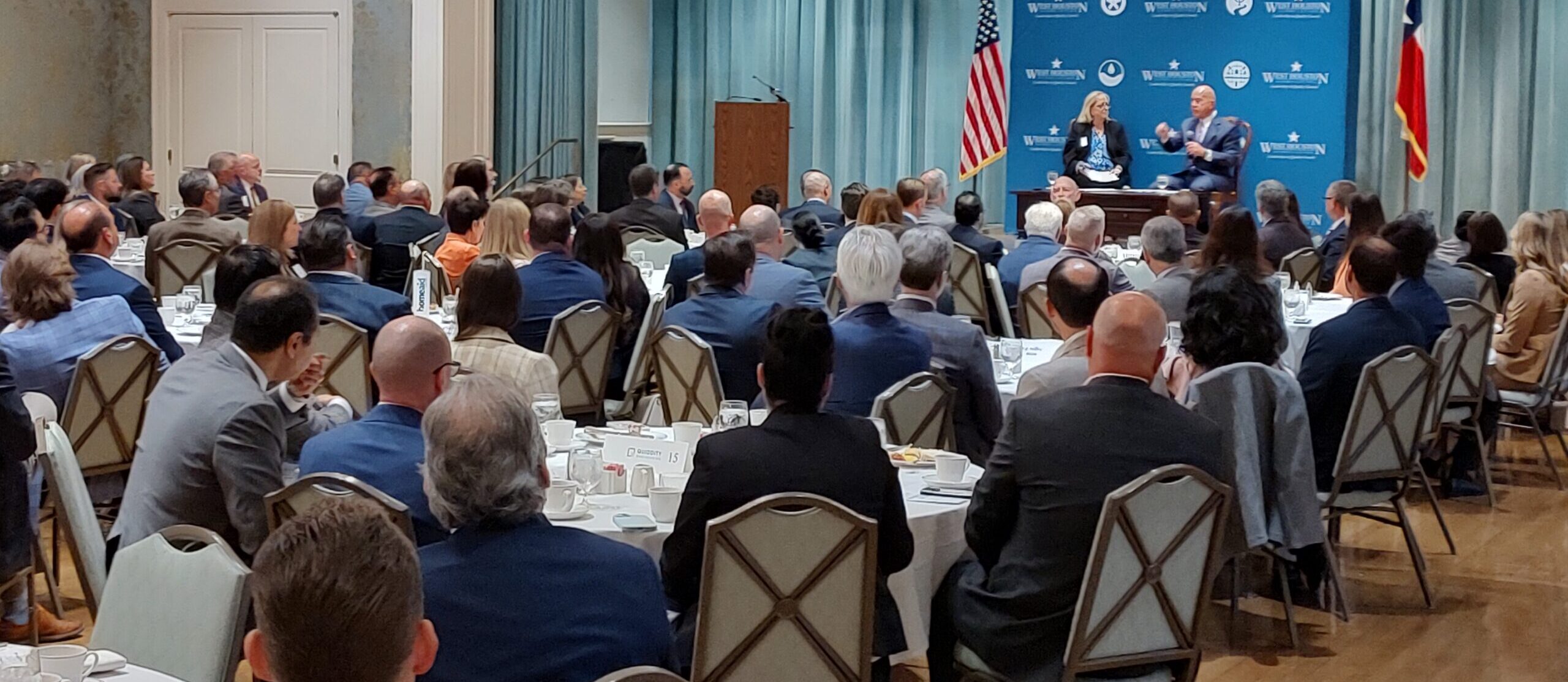
To help focus the community on possible solutions to this crisis, the West
Houston Association hosted a timely Transportation Issues Forum featuring a
panel of:
• State Senator Glenn Hegar,
• Harris County Judge Ed Emmett and
• Texas Transportation Commissioner Ned Holmes.
Association Board member Joe B. Allen of Allen Boone Humphries Robinson LLP
acted as moderator.
Senator Hegar said he believed the Texas Legislature would not act to
increase the motor fuels tax or other related fees in the next legislative
session. He cited the shortfall in the state budget, projected to be as much
as $18 billion, and other legislative priorities such as redistricting and
public education. On the matter of local option fees it will be a hard sell
to members. He mentioned that in previous sessions that addressed local
options, legislators have been asked to vote for taxing authority without
getting of the benefit because their districts lay outside metropolitan
areas.
Overall, the Trans-Texas
Corridor project “poisoned the well” among the public and the Legislature.
Although attitudes are improving, TxDOT has a long way to go to restore
confidence. As a result of the soured attitude, further public-private
partnerships, a hallmark of the Trans-Texas Corridor effort, will be allowed
only on a “case by case” basis
On TxDOT Sunset, the Senator
discussed the current management audit and its recommendations which if
implemented would affect many of the items cited by the Sunset Commission in
its last evaluation of Transportation Department. Because of this the
Senator as chairman of the Sunset Advisory Committee will wait until late
2010 to schedule additional Sunset hearings on TxDOT.
Judge Ed Emmett discussed Harris County’s toll road projects—completing
Beltway 8 East and the Hardy Toll Road Connector to the CBD—which are state
highway projects over which the county exercised primacy with the intent of
completing expansion via toll financing. He also said the county was
progressing on design of Grand Parkway Segments F1 & F2. However other
projects—SH 288, Hempstead Toll Road—are advancing more slowly. Judge Emmett
said that progress on these projects would require a form of public-private
partnership.
The Judge said the US 290/Hempstead Tollroad is a very complex project. The
Hempstead Tollroad is an extremely costly project and the reduced congestion
benefit for the corridor would be more inexpensively achieved by providing
relievers to US 290 such as Segment E of the Grand Parkway and the 290
Commuter Rail. Judge Emmett added that the county was willing to
consider giving up primacy on the Hempstead Toll Road (and possibly others)
particularly if there is a commitment to use local engineers and
contractors.
Transportation Commissioner Ned Holmes acknowledged the problems caused by
the Trans-Texas Corridor program. He said that project was devised as a new
way of developing transportation projects for the future of Texas. It did
have problems and poisoned the relationship between TxDOT, the public and
the Legislature. However, he said that program was initiated by the
Transportation Commission and that they deserved the blame for its failures,
not TxDOT staff.
Commissioner Holmes stated that the current TxDOT funding forecasts and
state allocations result in the Houston District scheduled to receive new
capacity project funding of only $589 million for 10 years, or about $60
million per year. This contrasts sharply with the recent years when the
Houston District had annual funding well over $800 million for ‘03, ‘04 and
‘05 and averaged $653 million from 2001 to 2010.
The Commissioner added that to overcome this crisis will require a new
funding formula and new, stable sources of revenue. We will overcome the
challenge but “when” is the question? We are in real trouble and the
business community will need to help give the Legislature “political cover”
to step up and make the votes needed to overcome the funding problems.
Read this report in PDF format at this link.
|
|