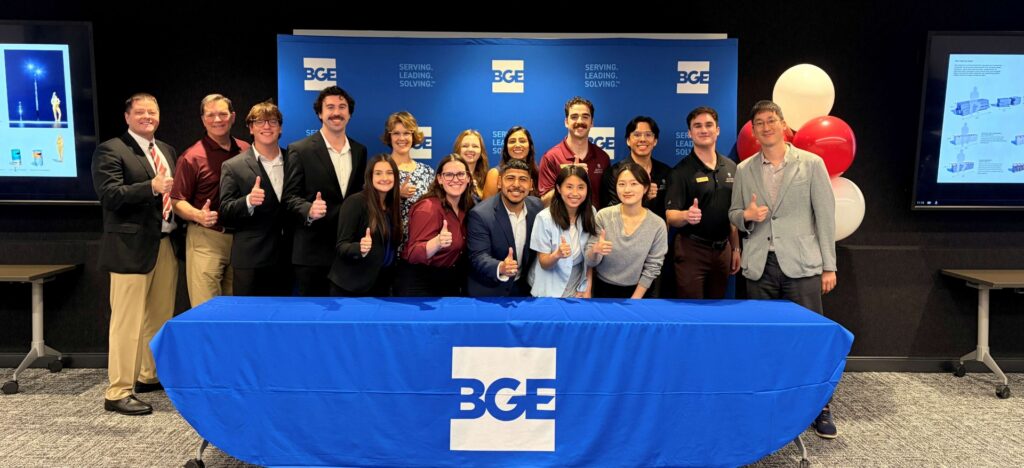
 Good ideas matter, but what makes them truly valuable is the ability to move them toward implementation. That was the spirit behind our half day event, “Connecting Ideas to Implementation: A Texas A&M Capstone Showcase” on May 1, which brought together students, faculty, and industry professionals for a morning focused on how design, planning, and development can respond to real challenges facing Texas communities.
Hosted at BGE, the showcase highlighted a wide range of student work from the Department of Landscape Architecture and Urban Planning, but a common thread ran through each presentation. These projects were not abstract classroom exercises. They were grounded in real places, real constraints, and real opportunities. Together, they demonstrated the value of applied learning and the importance of creating stronger connections between academic research and the professionals working every day to shape communities across the region.
 First up were students from the Landscape Architecture program presenting, “The Big U: Mending the Ground Through Earth, Water, and Connection;” delivered by Kaitlyn Acosta-Ruiz, Benjamin Campos, Aimee Chieh-Ling Jao, Emily Moon, and Margo Payton, with guidance from Dr. Dingding Ren and Dr. Zhenhang Cai. The project focused on the Lake Forest neighborhood in east Houston, responding to a set of challenges that are familiar across many parts of the region: flooding, environmental pressures tied to nearby industrial activity, and limited mobility infrastructure. The team proposed a nature-based design strategy that integrated green infrastructure, flood mitigation systems, and multimodal transportation improvements to enhance both environmental performance and quality of life. Key interventions included interconnected green spaces, rain gardens, constructed wetlands, and phytoremediation landscapes, organized around Talton Bend Park, the Preserve at 21 Acres, and the Mesa Drive corridor. The result was a compelling vision for how ecological repair and stronger community connections can move forward together.
 The Urban Planning presentation, “Embracing the Rural Life: Parks, Recreation, and Open Space Activation in Burton, Texas,” was presented by Madison Garcia, Jake Gordon, Gabriel Solis Guizar, Alicia Johnson, Jace Knight, and Travis Pharr, with Dr. Ivis Garcia serving as faculty coordinator. Their work centered on how a small Texas town can strengthen quality of life through thoughtful investments in parks, trails, and public space. The project identified Burton’s Indian Creek area as an underutilized asset and developed a strategy focused on community engagement, nature preservation, historical and educational value, and safety-first design. Recommendations included trail connectivity, educational signage, interactive gardening, improved lighting, and partnerships that could help transform Indian Creek into a more visible and functional community amenity. It was a strong reminder that implementation is not only about large-scale urban interventions. In smaller communities, strategic open space investments can also preserve local character while creating safer, more welcoming places for residents.
 The third presentation, “BTR Community: Montgomery County, TX,” came from Masters of Land Planning and Development students Sebastian Guerra, Tyler Jennings, and Adam Tate, under the guidance of Professor Tim Early. Their capstone focused on transforming a 60.64-acre site in Conroe into a viable build-to-rent community, beginning with very limited information and building the proposal from the ground up. Over the course of the semester, the team conducted due diligence, market research, and marketing strategy development while adapting to new information from ESA reports, soil studies, and other technical documents that shaped the site plan and achievable unit count. Just as important, the project reflected the need to balance product type, market demand, political and economic conditions, and financial feasibility. In a fast-growing region, that combination of vision and rigor is essential. This project underscored that successful development is not just about what can be imagined, but what can actually be delivered.
 The final presentation, “From Dumping Grounds to Living Systems: The Great Fifth Ward,” was presented by Master of Landscape Architecture student Jee Park, with Dr. Sungmin Lee as capstone professor. The project addressed illegal dumping in Houston’s Greater Fifth Ward by reimagining dumping-prone vacant land as a connected system of material recovery, community use, and ecological stewardship. Rather than treating waste solely as a nuisance to be removed, the proposal reframed it as an opportunity to create visible public value. Vacant parcels, street edges, and dumping hotspots were envisioned as recovery hubs, learning gardens, art exhibition spaces, smart waste collection stations, and green corridors. Recovered materials such as concrete, glass, wood, tires, and metal were incorporated into seating, paving, signage, artwork, and habitat structures. The project offered a powerful example of how design can respond to persistent neighborhood challenges in ways that strengthen identity, improve visibility, support everyday use, and build long-term stewardship.
Taken together, the four presentations demonstrated the breadth of issues that emerging professionals are already tackling—from flood resilience and environmental repair to rural placemaking, housing feasibility, and neighborhood revitalization. They also showed the value of interdisciplinary thinking. Landscape architecture, planning, and development each bring different tools to the table, but the strongest outcomes often come when those disciplines are in conversation with one another.
That is part of what made this showcase so worthwhile. For the West Houston Association and its members, events like this create an opportunity to engage with fresh thinking while also encouraging the next generation of professionals to stay closely connected to the practical realities of implementation. For students, it reinforces that their work can contribute to real conversations about how Texas communities grow, adapt, and invest for the future. For practitioners, it is a reminder that academic partnerships can be a meaningful source of creativity, insight, and problem-solving.
As Greater Houston continues to navigate questions of growth, infrastructure, resilience, redevelopment, and quality of life, the need for thoughtful, implementation-minded ideas will only grow. The Texas A&M Capstone Showcase offered an encouraging look at the future. It reflected not only the talent of the students involved, but also the value of partnerships that bring together universities, civic organizations, and industry leaders around shared challenges.