
This year our Regional Mobility Committee’s Mobility Excellence program will recognize Harris County Precinct 4’s Sidewalks 4 Precinct 4 Initiative, and Harris County Precinct 3’s Memorial Drive Roadway Improvements Project. The committee created the Mobility Excellence program to recognize transportation projects that positively impact the Greater West Houston region and beyond. The program highlights notable work that improves safety, connectivity, resiliency, economic development, innovation, and community integration.
Both of the recognized projects address different aspects of the regional mobility system. The sidewalk initiative bridges pedestrian network gaps across a large and diverse geographic area. The Memorial Drive project renews an important existing corridor while maintaining its established capacity and character. Both projects demonstrate how coordinated planning, sound engineering, and strategic use of public resources can improve mobility and support quality growth.
Sidewalks 4 Precinct 4
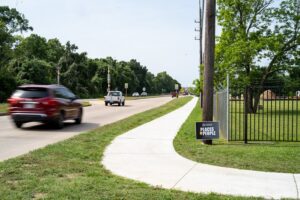
 The Sidewalks 4 Precinct 4 project addresses missing links in the pedestrian network that create unsafe pathways or impede residents from reaching schools, parks, transit stops, healthcare facilities, commercial centers, and employment opportunities.
Through the initiative, over 100 miles of pedestrian infrastructure will be constructed across Precinct 4 at the program’s conclusion. The project area extends from west of the Grand Parkway to west of Eldridge Road and from Mission Bend north to areas beyond FM 529.
The approximately $36 million investment is notable for both its scale and its delivery strategy. Precinct 4 developed four delivery tracks and a prioritization methodology that combines available data with community input. The program also uses interlocal agreements and funding from partner agencies to expand the number and geographic reach of projects that can be completed.
The ability to integrate sidewalk construction into larger roadway, drainage, and capital improvement projects is an important component of the program. Coordinating these improvements reduces duplication, limits frequent disruptions within the public right of way, and allows for pedestrian infrastructure delivery within a more complete transportation system. The initiative also provides an example of how public agencies can incorporate mobility improvements within the scope of already planned or in-progress infrastructure work. Community engagement helped to determine where sidewalks were most needed. Precinct 4 collected information through town halls, listening tours, 311 requests, and calls for projects. Citizen input was then evaluated alongside data related to schools, transit access, pedestrian safety, community needs, and the Social Vulnerability Index.
The resulting improvements will remove barriers to mobility, particularly in locations where residents have limited transportation choices. New sidewalks will meet Texas Accessibility Standards and the Americans with Disabilities Act requirements and provide safer, more direct routes between neighborhoods and frequently visited destinations.
Transit connections are vital since a transit system will be used more frequently if it is favored by a convenient to access and expansive service area. By improving pedestrian connections along transit corridors, Sidewalks 4 Precinct 4 strengthens first-mile and last-mile access while amplifying investments in existing public transportation.
The project also supports Vision Zero objectives by reducing pedestrian and vehicle conflicts. Providing a dedicated pedestrian path is crucial near schools where missing sidewalks force children and families to walk along unsafe roadway shoulders or cross streets.
The economic benefits extend beyond safety. Improved pedestrian access connects workers with jobs, brings customers to commercial properties, and makes nearby sites more accessible to a larger population. For landowners and developers, a more complete pedestrian network can also support the long-term functionality and marketability of surrounding properties.
Sidewalks 4 Precinct 4 complements other public investments, including the approximately $2 million ARPA-funded Alief Street Forest Project. Together with crime prevention through environmental design principles, these improvements are making safer, more comfortable, and better integrated corridors with neighborhoods.
The program gathered professionals from Precinct 4, Harris County Engineering, DCCM, InfraTech, and J. Rivas Construction. Precinct 4 will provide long-term maintenance, thus helping to protect its investment and ensuring that the completed infrastructure continues to serve the community.
By combining data-informed prioritization, public engagement, multiple funding sources, coordinated project delivery, and a defined maintenance partner, Sidewalks 4 Precinct 4 provides a model that can be applied to pedestrian infrastructure programs throughout the region.
Harris County Precinct 3 Memorial Drive Roadway Improvements
Harris County Precinct 3’s Memorial Drive Roadway Improvements project demonstrates how regional cooperation and timely rehabilitation can extend the service life of existing transportation infrastructure while also preserving the character of its surrounding area.
Led by Precinct 3 Commissioner Tom Ramsey in partnership with METRO, the approximately $2.76 million project rehabilitated 2.7 miles of Memorial Drive between San Felipe Street and just west of Chimney Rock Road. Approximately $2.58 million of the total investment was dedicated to construction.
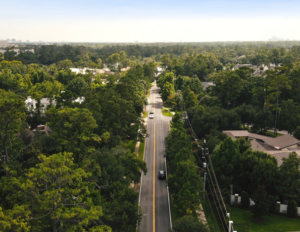 This segment of Memorial Drive carries approximately 11,500 vehicles per day and supports commuter traffic, neighborhood travel, public transportation, school traffic, and emergency services. The corridor also provides access to two schools and associated school zones, two parks, the Houston Racquet Club, nearby businesses, and surrounding residential communities.
The project addressed deteriorated pavement while retaining the roadway’s existing lane widths and configuration. Rehabilitation within the established roadway footprint extended the corridor’s useful life without adding capacity or substantially changing the residential setting of the Memorial communities.
This approach reflects an important element of infrastructure stewardship. Timely rehabilitation can address surface deterioration and localized structural failures before conditions require a more extensive and costly reconstruction project. Targeted maintenance protects previous public investment while maintaining a corridor’s level of service.
Designed by WSB and constructed by Durwood Greene Construction, the project included milling worn asphalt, repairing localized base failures, and resurfacing the roadway. Existing asphalt driveways were replaced, and asphalt covering designated concrete driveways was removed to expose the original concrete. New reflective pavement markings improved roadway delineation and visibility at night and during adverse weather.
The project also rehabilitated pavement adjacent to 33 METRO bus stops. This component improved access to bus operations and extended the project’s benefits to transit users.
Project delivery required coordination among Harris County Precinct 3, METRO, the City of Houston, Piney Point Village, and Hunters Creek Village. The corridor crosses jurisdictional boundaries, making cooperation among the participating agencies essential to resolving design, construction, access, funding, and maintenance considerations.
Community forums gave residents and commuters opportunities to provide input. Coordination meetings among the participating entities also helped shape the construction approach and traffic management plan.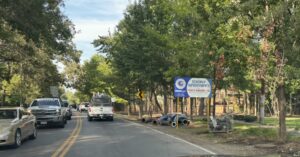
Construction began in February 2026 and was completed in July. The project’s traffic safety plan allowed work to proceed without fully closing Memorial Drive. Maintaining access was critical for residents, businesses, school traffic, transit service, and emergency responders. The safety plan also reduced adverse economic and operational impacts commonly associated with work on a heavily traveled corridor.
The Memorial Drive Roadway Improvements Project provides a strong example of responsible asset management. The program used targeted rehabilitation, coordinated funding, and intergovernmental cooperation to improve roadway conditions and extend pavement life while avoiding the high costs and negative community impacts associated with larger reconstruction or widening projects.
Sidewalks 4 Precinct 4 and the Memorial Drive Roadway Improvements Project illustrate the range of investments needed to support regional mobility and quality growth. While one is building new pedestrian infrastructure across rapidly changing communities, the other is preserving the performance of an established roadway that supports multiple jurisdictions and transportation needs.
Both projects reflect the purpose of WHA’s Mobility Excellence program. Through careful planning, professional collaboration, community engagement, and responsible capital investment, they improve the function of the regional transportation system and provide useful models for future infrastructure projects across Greater West Houston.