

West Houston’s continued growth presents an opportunity to rethink how parks, trails, and green spaces connect communities across the region. At last week’s West Houston Association forum, leaders from Harris County Precinct 4 and Houston Parks Board discussed what it would take to create a regional trail network that crosses jurisdictional boundaries, connects neighborhoods, and turns existing infrastructure into recreational assets.
Moderated by WHA Board Member Matt Stoops, Senior Director of Planning & Landscape Architecture at LJA, the panel featured Harris County Precinct 4 Commissioner Lesley Briones, Houston Parks Board President & CEO Justin Schultz, and Barron Wallace, Partner at Bracewell LLP and former chair of Houston Parks Board. The conversation explored the economic and community benefits of trails, potential funding mechanisms, and the partnerships needed to move a regional vision from concept to construction.
Why Connectivity Matters
Commissioner Briones began the conversation emphasizing that trails and sidewalks are more than recreational amenities. They are essential investments in public safety, economic development, and quality of life.
“If we want to continue thriving as a region, from a quality of life perspective, from a safety perspective, and from an economic development perspective, we need green space. We need connection. We need safety,” Briones said.
Her vision is for every resident to live within a 10-minute walk of a park or green space, one shared by the Trust for Public Land and the Urban Land Institute. An ambitious goal that will require substantial investment and collaboration in the greater Houston region. Briones highlighted Precinct 4’s progress in pedestrian infrastructure, including more than 80 miles of new sidewalks constructed in approximately two years. The precinct has partnered with Katy ISD, Alief ISD, and Cy-Fair ISD to prioritize connections around schools, using pedestrian safety data to identify dangerous gaps. The precinct has also improved approximately 120 crosswalks, benefiting more than 30,000 students. These investments are part of a broader approach to infrastructure. Briones reported that Precinct 4 has developed 69 partnership projects representing approximately $332 million in investments.
“When we leverage our dollars, leverage our vision, we can get so much done,” she said.
Expanding the Bayou Greenways Model Westward
Houston Parks Board has spent more than a decade developing Bayou Greenways, building and connecting more than 170 miles of trails. Much of that investment has historically focused on central Houston, but Schultz noted that the region’s population and economic activity continue to expand westward.
“The west side needs all the same amenities, all the same benefits that every other part of Houston has,” Schultz said.
The challenge is that West Houston’s development and governance differ significantly from central Houston. Municipal utility districts (MUDs), management districts, developers, counties, and municipalities all play important roles in building and maintaining infrastructure. Wallace emphasized that these entities should be seen as strengths rather than obstacles. In particular, MUDs can provide long-term maintenance funding and a direct connection to the residents who benefit from trails.
“I can’t think of a better model, frankly, than a MUD,” Wallace said, noting their ability to support maintenance and remain connected to neighborhood priorities.
He stressed that successful trail projects require more than construction funding. Contracts, maintenance agreements, and clearly assigned responsibilities are necessary to ensure infrastructure remains valuable for decades. Schultz explained that Houston Parks Board can contribute expertise in fundraising, design, construction management and community engagement. Its public-private partnership model has already demonstrated how separate funding sources and jurisdictions can support a unified trail system.
A Potential 18-Mile Connection
Schultz described the proposed corridor as potentially extending up to 18 miles, creating a major connection between two significant green spaces in West Houston. The feasibility study, supported through a partnership with Harris County Precinct 4, will examine land ownership, possible alignments, community needs, and potential partners. It represents an important early step toward understanding what can realistically be constructed. Schultz cautioned that regional trail projects can take years, sometimes a decade, because of design requirements, permitting, land acquisition, and coordination among agencies. However, he also emphasized that regional planning and individual trail segments do not necessarily need to proceed sequentially. Some corridors may require extensive planning, while smaller connections could advance more quickly. Wallace agreed that early projects can create momentum. “You need to plan, but you also need to figure out what you can do to make things better as fast as you can,” he said. The discussion reinforced the importance of establishing a regional vision while identifying achievable projects that demonstrate benefits and build public support.

Making Infrastructure Serve Multiple Purposes
Another major opportunity lies in using existing infrastructure corridors for trails and recreational amenities.
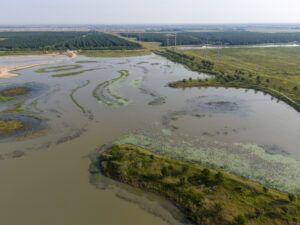
West Houston contains extensive bayou systems, detention basins, utility easements, and pipeline corridors. Rather than treating these properties as serving only one function, panelists encouraged creative partnerships that deliver multiple community benefits.
“We don’t need any more ugly detention basins,” Briones said, encouraging developers and public agencies to consider how required flood-control infrastructure could also provide amenities for employees, neighborhoods, and surrounding communities.
Schultz pointed to examples where Houston Parks Board has worked with the Harris County Flood Control District partners to create parks within detention facilities. He highlighted a new park in Sunnyside, Hill at Sims, featuring five miles of trails, wooded areas, public art, and a large hill created from excavation material.
He also identified CenterPoint transmission easements as opportunities for connectivity, noting that the Spring Branch Trail demonstrates how utility corridors can accommodate recreational infrastructure.
“How can we be creative about the infrastructure that’s already there and turn it into multi-benefit infrastructure?” Schultz asked.
Stoops added that pipeline easements represent another potential resource in a region already crossed by numerous utility corridors.
For West Houston, integrating trail planning into drainage improvements, utility projects, and new development could reduce barriers to creating a connected network.
Funding and Long-Term Sustainability

Building trails is only part of the challenge. Maintaining them through changing budgets and elected leadership requires durable institutional commitments.
Wallace suggested that a regional park authority could eventually provide a more permanent governance structure, although no such entity currently exists. In the meantime, he emphasized the importance of interlocal agreements that establish clear, long-term responsibilities.
Philanthropic partners, he explained, need confidence that their investments will be maintained well beyond the current election cycle.
Schultz pointed to Bayou Greenways as a successful example. The Kinder Foundation’s $50 million commitment helped establish the program, while an agreement with the City of Houston provided a long-term maintenance funding mechanism extending up to 80 years.
That stability helped attract additional private investment. Houston Parks Board has raised more than $150 million privately for Bayou Greenways, exceeding the $100 million authorized by Houston voters in 2012.
The broader lesson is that long-term maintenance commitments can be just as important to fundraising as the initial project vision.
Community Engagement and the Path Forward
Throughout the discussion, panelists returned to the importance of community involvement.
Briones argued that residents must help shape projects from the beginning rather than simply be consulted after major decisions have been made. She cited the redevelopment of Burnett Bayland Park in Gulfton, where the precinct gathered more than 20,000 community data points across seven languages.
“If a partnership is going to stick, it has to be driven by the community it is intended to serve,” she said.
Wallace emphasized that documenting community demand and measuring trail usage can help secure continued government and philanthropic support. Schultz added that completed projects often become their own best advocates, as residents discover the convenience and recreational benefits of nearby connections.
As the forum concluded, panelists encouraged attendees to continue building relationships and identifying opportunities across jurisdictional boundaries.
Schultz emphasized that Houston Parks Board’s mission extends beyond Houston’s city limits, welcoming partnerships with Fort Bend County, Waller County, Katy, Sugar Land, Jersey Village, and other communities.
For West Houston, the opportunity is to combine an ambitious regional vision with practical near-term investments. The emerging Langham Creek feasibility study offers one potential starting point, but the larger goal is a connected trail system that strengthens neighborhoods, enhances quality of life, and supports the region’s continued growth.
As Wallace concluded, “Keeping the conversation going is the most important thing.”