
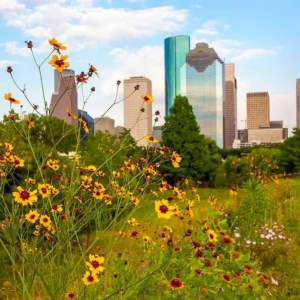
Native grasses and wildflowers at Buffalo Bayou Park demonstrate how Houston can integrate resilient natural systems into a rapidly growing urban landscape.
In the rapidly urbanizing Houston landscape, the conventional approach to growth often comes at a high cost to natural infrastructure. As concrete replaces our coastal prairies and piney woods, natural drainage patterns are altered, increasing stormwater runoff and pollutant loads in local waterways. However, a transformative shift is occurring in our communities—one that views native plants not just as landscaping, but as a practical, high-performance tool for resilient growth.
At its core, the use of native plants in urban development mimics pre-development flora and hydrology. Unlike non-native or “store-bought exotics,” Texas native plants have evolved over millennia to withstand the region’s harsh cycles of intense rainfall and prolonged drought.
The most significant advantage of these plants lies beneath the surface. While traditional turf grass offers little in the way of enhanced soil stability or infiltration, native species such as Big Bluestem and Eastern Gamagrass possess networked root systems that can reach depths of 10 to 20 feet. This combined root structure serves some key functions. First, they “net & anchor” topsoil to deeper strata, providing internal strength to streambanks and slopes to prevent slumping. They also create macropores in the soil, which are pathways that rain and stream waters can follow deeper into the soil, promoting deep infiltration and allowing the ground to act like a sponge rather than a slide. Perhaps most importantly, this living plant material and their associated soil microbes capture and biologically degrade pollutants—such as nitrogen, phosphorus and heavy metals—before they reach our streams and reservoirs. This acts as a pre-treatment system, reducing exposure to our native wildlife and ultimately lowering our costs to provide safe and reliable drinking water for our communities.
Native plantings are the engine that powers these diverse strategies. By matching the right species to each community’s unique water and soil conditions balanced against the drainage infrastructure needs, developers can create self-sustaining systems that reduce both capital and long-term maintenance costs.
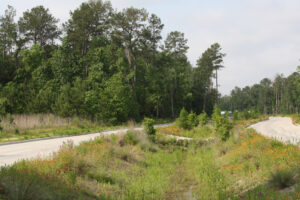
Native vegetation along Birnamwood Drive helps capture, filter, and absorb roadway runoff while reducing conventional drainage and maintenance costs.
In linear bioswales and depressed rain gardens, flexible species that tolerate both standing water and dry spells are essential. There are many great species which are successful in this environment. A few spotlight varieties are the Louisiana Iris, Spider Lily and Virginia Sweetspire, all of which are native to the Houston region and produce attractive blooms, with the Sweetspire notably providing a double benefit of erosion control.
Micro-forests and riparian corridors also provide great opportunities to showcase our native vegetation. “Micro-foresting”—the practice of planting small, dense and biodiverse forests—is a powerful tool for redeveloping community “dead zones” like dry detention basins. For use in detention basins, a combination of single-trunk trees and grasses are recommended as they do not significantly reduce the holding capacity of the basin nor impede the flow of water. Of note there is the Bald Cypress, which is a long-lived sentinel of the floodplain, with feathery leaves turning rust in the fall, and it can survive prolonged inundation. Burr Oak is another great species as it is extremely long-lived and drought-tolerant with a deep taproot, making it ideal for sandy ridges and stream edges. Drummond Red Maple also makes a handsome addition as it provides early-season color and serves as a vital host plant for native butterflies. These can be combined with native grasses best suited for the soil and water conditions of the basin, together reducing both erosion and maintenance costs. Doubly, these same species can be incorporated along riparian corridors, the green buffer zone along creeks and bayous, to provide the same benefits and may even be placed to occlude and enhance flood control features.
When looking for large-scale soil stabilization the “Big 4” prairie grasses—Big & Little Bluestem, Indiangrass and Switchgrass—are unmatched. Big Bluestem provides striking visual dominance, reaching heights of 6 to 8 feet, while being both flood and drought tolerant. Little Bluestem is a more modest grass with a height of 2 to 4 feet, shifting from a stunning blue-green in summer to a lush orange red in winter, and is particularly forgiving of poor soil conditions. Indiangrass provides rustic ornamental value with gold-toned seed heads and its ability to thrive in various soils. Lastly, Switchgrass is wonderful in its quick establishment to provide erosion control and is well suited for damp, heavy soils.
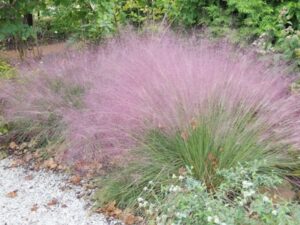
Pink Muhly provides vibrant seasonal color while offering a low-maintenance, drought-tolerant alternative to traditional landscaping.
Two other grasses are particularly notable. Pink Muhly is a vibrant ornamental grass with purple-pink plumes that provides a similar visual appeal to bushes at a fraction of the maintenance effort. Buffalograss is a shorter-growing native that finds great value where higher visibility is required, such as around manholes or utility structures. Both also aid in erosion control and can thrive solely off rainfall once established.
No single tree, grass or lily is a silver bullet as these species support each other, each filling in the gaps of the others. Indiangrass does slightly better in sandy soils with good drainage but can suffer in the dense soil Switchgrass loves. Sweetspire and Muhly provide great velocity breaks but can block drainage outfalls, which is balanced by Buffalograss. The knobby knees of Cypress are great for streambank stabilization but can make annual maintenance difficult in the flatter areas that Oak thrives in.
This naturalization of urban infrastructure is not relegated just to new developments. Existing communities, homeowner’s associations (HOAs) and municipal utility districts (MUDs) can all experience the ecological and financial benefits of native plantings. Roadside ditches can be converted to bioswales, large linear channels into a riparian oasis and dry-bottom detention ponds into micro-forests complete with walking trails.
The shift toward native plantings is driven as much by the bottom line as by environmental stewardship. Conventional landscapes with exotic plants and high-mow turf are expensive to maintain, requiring constant irrigation, fertilizer and labor. Native projects in the Houston-Galveston region have demonstrated significant savings. For example, the Birnamwood Drive pilot project used bioswales with native species in the roadway median. By eliminating the need for an extensive storm sewer system and traditional detention ponds, the project cost $300,000 less than a conventional design. Furthermore, maintenance costs dropped significantly; while traditional roadways are mowed quarterly, Birnamwood Drive only requires mowing twice a year once the native plants are established.
Similarly, at Fosters Ridge in Montgomery County, the use of drought-tolerant native plantings adorn the entryway into each neighborhood and provide a “no-mow, no-water” erosion solution to the creek which serves as the central drainage outfall to the subdivision.
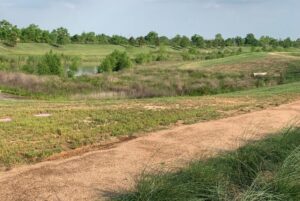
Elyson’s landscape palette draws from the Katy Prairie, integrating native grasses, wildflowers, trees, trails, and open space into a growing community.
Other regional developments also show how naturalized landscapes, native plant palettes, and green infrastructure can help create both community identity and long-term resilience. Elyson in Katy has used a landscape palette that celebrates the Katy Prairie, including native trees, wildflowers, meadows, and ornamental grasses. Cross Creek Ranch in Fulshear is known for using waterways, open space, trees, trails, and natural surroundings as defining features of the community. Bridgeland in Cypress has similarly treated parks, lakes, trails, and open space as essential infrastructure within a large-scale master-planned community. These examples reinforce an important point: native and naturalized landscapes are not just environmental features. They can be marketable amenities, drainage assets, and long-term maintenance strategies.
A primary barrier to the widespread adoption of native plants is the perception that bioengineered projects look “weedy” or unkempt. For those accustomed to the manicured look of a traditional New England lawn, a natural Texas prairie or riparian zone can be a significant change.
However, modern urban design emphasizes a “multifunctional landscape”. Native plantings can be designed with intentionality, using different heights and textures to create attractive public amenities. Strategic signage can educate the public, explaining that these “Native Grasses” are working infrastructure that protects the community from flooding and pollution.
For the development community, design and maintenance expectations must be clear from the beginning. Native plantings should be coordinated with grading, drainage design, outfalls, sight lines, access needs, utility locations, and long-term maintenance responsibilities. When engineers, landscape architects, developers, operators, and future maintenance entities are aligned early, native plantings can support both sustainability and resilience without creating unnecessary operational challenges.
As the Houston-Galveston region prepares to welcome millions of new residents and strives to create heartfelt communities for our native Texans, the choice is clear: continue with expensive, rigid infrastructure that fights natural forces, or embrace the resilient, self-sustaining power of native Texas plants. By integrating species like Little Bluestem, Bald Cypress and Louisiana Iris into our urban fabric, we can build a region that is not only growth-oriented but truly sustainable for generations to come.