
Low Impact Development (LID), a tossed-around term with more whispered stories than the haunted bars of downtown Houston. While there are no haunted elevators, spooky vaults, or Prohibition-era trap doors, LID is still discussed in hushed tones across Harris County.

Low impact development in commercial development
At its core, LID is a stormwater management strategy that mimics pre-developed hydrology. This approach is the opposite of traditional design. While traditional design focuses on moving water off a site as quickly as possible, LID takes the opposite path—holding water on site for as long as possible and preventing it from gaining speed. This opposing force to the civil engineers’ and land developers’ mindset of “I’ve always done it this way” is a common reason for the avoidance of LID and why its mystery persists.
“LID is expensive to maintain,” “LID is complicated,” or “LID is not developer-friendly” are phrases easily regurgitated by the masses as justification for not learning a new practice. Yet LID continues to persist—much like native Texas plants pushing through the cracks of old concrete, a constant challenge to these false narratives, as if resisting a verbal herbicide.
The brave developers who wander into these dark caverns, torches of innovation lighting the way, often find the tunnels glittering with veins of gold and silver. Within, they discover unexpected assistance from motivated civil engineers, landscape architects, consultants, and even municipalities willing to lend a hand. In 2011, Harris County released its LID Manual, setting the stage to encourage LID throughout the county. Seeking to be a lighthouse amid the ever-growing storm of urban development and crumbling infrastructure, Harris County created a pathway toward greater resiliency and sustainability. Legend has it that during a 2011 conference, a man on stage proclaimed, “LID would never work in Harris County!” That challenge was taken up by experts across the land development industry, determined to prove otherwise.
From that single outburst, the Low Impact Development Manual became a reality. It introduced previously unheard-of incentives, such as reducing stormwater detention requirements by up to 40%, while maintaining permitting timelines comparable to traditional design. Creativity was placed back into the hands of consultants, allowing them to prove their designs rather than being constrained by the bumpers of “sufficient” engineering. Champions of LID carried this message across Harris County, delivering successful LID designs across a wide range of land development sectors.

Low impact development in residential development, also known as rain gardens
Single-family neighborhoods achieved 10–20% more lots—one development grew from 224 lots to 323—while reducing construction costs by hundreds of thousands of dollars. Some developers were even reimbursed by TCEQ for their LID features because they were considered part of the local infrastructure. Commercial developers reclaimed valuable land or avoided the cost of expensive underground detention vaults. Multi-family and industrial developments gained additional buildings or became viable projects once again. Walmart and ExxonMobil headquarters were built around LID designs. Capital Improvement Projects realized construction cost savings of 4–7% per mile when designing LID roadways.
If memory serves, Village Green Alzheimer’s Care Homes across Harris County are great examples of LID in commercial real estate. Upon realizing the benefits of using LID for drainage, they saved hundreds of thousands of dollars in construction costs compared to installing underground detention or losing too much land to a detention pond. As a result, LID became the standard in their facility development program.
Wanting to mix things up from their typical, another commercial developer at Jarvis and Telge decided to use LID for their 20-acre mixed use site. By incorporating bioswales across the property, they not only preserved massive, generational oak trees but also eliminated a significant amount of storm sewer infrastructure, reducing construction costs. They were then able to sell the additional commercial lots at a premium because they could provide detention for the entire site rather than just the multifamily portion.
When flooding reared its ugly head across Houston, LID sites—with 40% less detention—handled Tax Day and Hurricane Harvey with the same ease the Houston Astros handled their two World Series wins. Even 24 hours after these storms, LID sites were still holding water back, preventing downstream flooding, while many traditional developments had already discharged their runoff into overwhelmed waterways. One single-family developer even received letters of thanks from residents for using LID practices, as surrounding traditional developments flooded.
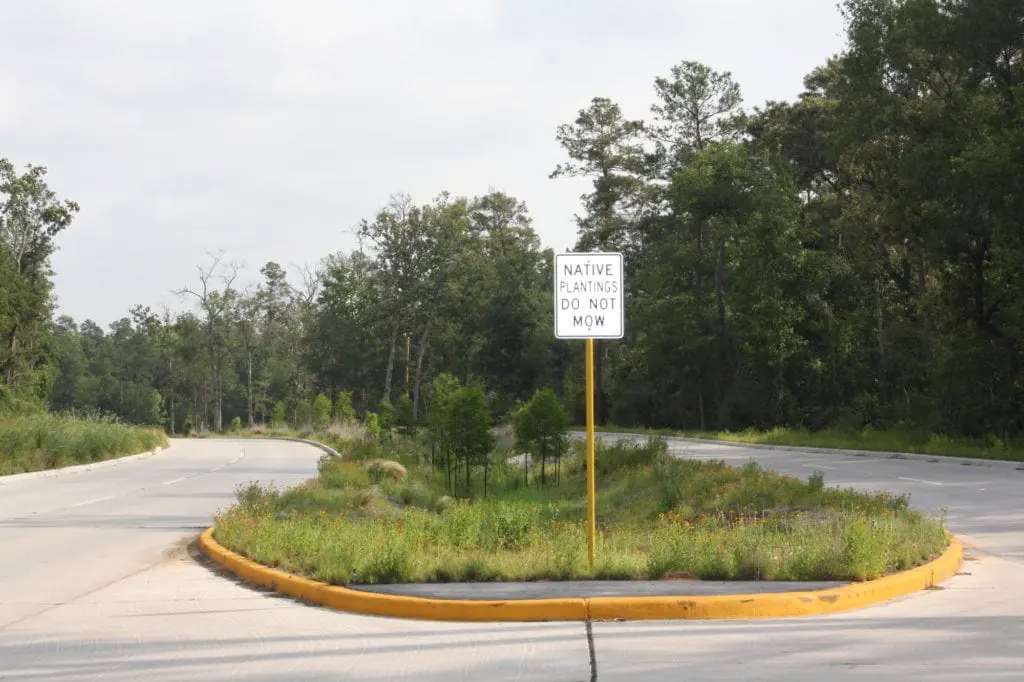
Low impact development in median
Over time, however, many of the original champions of LID moved on in their careers. With no one left to carry the mantle, misinformation began to creep back into the narrative. A tendril of inexperience took hold, fueled by the repeated claim that “LID has a high cost of maintenance.” These arguments often relied on case studies from before 2011 or from early adopters still navigating uncharted territory. What became clear was that maintenance costs were driven not by LID itself, but by planting schemes and installation choices. Store-bought exotics failed in Houston’s harsh climate and required constant replacement. Highly manicured landscapes demanded more labor than maintenance teams had anticipated, driving up long-term costs and feeding the rumor mill.
Stakeholders once again came together, sitting down with maintenance teams to identify where design practices needed to change. The conclusion was simple: simpler solutions work best. Annuals and exotic plants were replaced with native grasses and plants. Fertilizer nutrients—nitrates, phosphorus, and potassium—were already being conveyed to bioswales, where native plants thrived. Annual plant replacement was eliminated. Maintenance schedules shifted from biweekly visits during growing season to just a few visits per year. While individual visits cost more, overall maintenance costs dropped. Small signs reading “Native Grasses — Do Not Mow” educated the public. TxDOT followed suit, planting roadways heavily with trees after recognizing long-term maintenance savings compared to traditional sod grass.
Now, with the original champions of LID largely gone, a new generation of brave developers is needed to rise and take up the challenge. LID has proven itself developer-friendly through incentives and sound civil engineering. Through continued dialogue and a willingness to explore the deeper corridors of LID, new technologies and discoveries will emerge. For developers seeking an edge in an increasingly competitive market, LID can be that edge. For municipalities searching for long-term solutions to overburdened infrastructure, LID can be that solution. And for consultants striving to stand out in a crowded field, LID can be the design philosophy that carries them to golden shores.
