When Levy Park reopened in 2017, it quickly became clear that it was more than just a new green space. Families gathered under the shade trees, office workers spilled out during lunch hours, and weekend events began to fill the calendar. What had once been an underutilized site became a daily destination almost overnight. While the park’s popularity was immediately visible, its deeper impact took time to reveal itself. 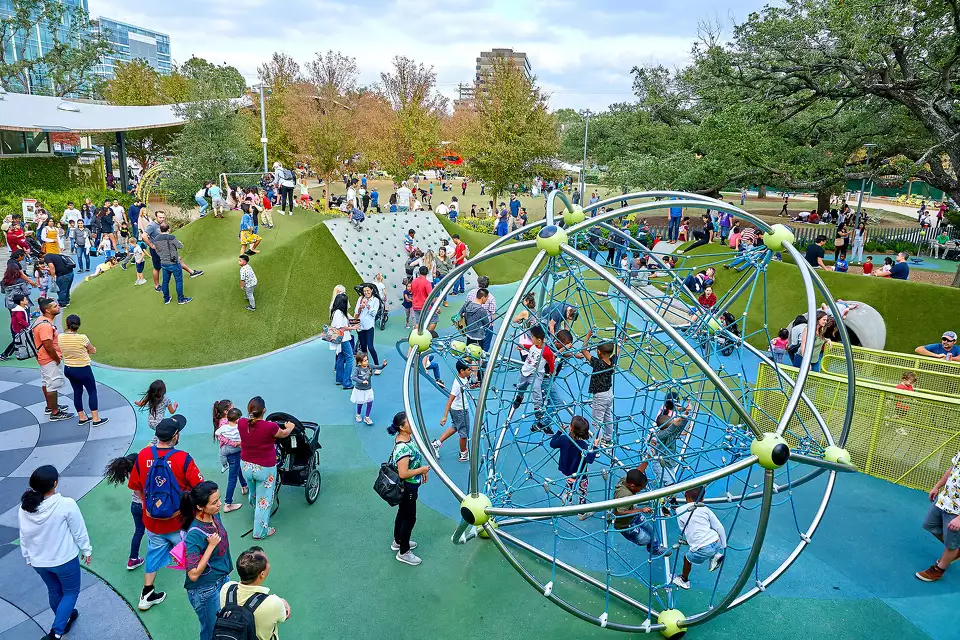
Several years later, the data tells a story that goes well beyond recreation or aesthetics. Based on analysis conducted for the West Houston Association, Levy Park offers one of the clearest examples in Houston of how strategic public investment, made possible through a Tax Increment Reinvestment Zone, can drive long-term economic value.

Map of TIRZ 19
(click to view)
The park sits within Upper Kirby’s TIRZ 19, an area today characterized by strong development activity and regional accessibility. Yet prior to the park’s redevelopment, the neighborhood lacked meaningful public green space. As density increased, that absence became more noticeable. The decision to invest in Levy Park was not about beautification; it was about strengthening the district’s long-term competitiveness and livability through quality of life improvements.
The results have been measurable.
WHA examined property values from 2013 through 2024, tracking parcels adjacent to the park, parcels within a quarter-mile radius, and comparable areas elsewhere in the city. Even before construction began, the Levy Park area was performing well. From 2013 to 2016, properties surrounding the future park site experienced annual growth of roughly 8.8%, slightly ahead of comparable areas. This suggested that the market already recognized the potential of the area and the impact that a major public investment could have.
What happened after the park opened, however, was far more striking.
In the two years following completion, properties immediately adjacent to Levy Park experienced an average annual increase in value of nearly 30%. That level of growth significantly outpaced both the broader TIRZ and comparable districts across Houston. Even parcels farther from the park saw strong gains, confirming that the benefits extended well beyond the park’s boundaries.
This pattern reflects what urban economists often describe as the post-construction effect. While construction can temporarily slow activity or introduce uncertainty, completion changes everything. Once a project is finished, the market responds quickly. Residents, businesses, and investors can see and experience the improvement firsthand, and confidence follows.
In the case of Levy Park, that confidence translated into sustained value growth. Over the full study period, parcels near the park added more than $175 million in new appraised value. When expanded to include the broader quarter-mile area, total value growth exceeded $360 million. This growth is more than double that experienced by other properties measured within the area, over the same time period. This growth also outperformed the overall TIRZ value growth rate over that period, by 1.2%.
During the analysis period, Houston endured Hurricane Harvey and the economic shock of the COVID-19 pandemic. Many areas experienced sharp declines or prolonged recovery periods. Yet properties around Levy Park demonstrated a remarkable ability to rebound. While values dipped in some years, recovery was faster and more consistent than in comparable areas.
This performance may be partially attributed to the park’s design, done by OJB – Houston. Levy Park incorporated stormwater management and resilient landscaping, allowing it to function not just as an amenity but as a form of green infrastructure. In doing so, it helped stabilize surrounding properties and contributed to the area’s overall recovery.
 “The park’s design highlights cutting-edge sustainability practices while offering visitors various opportunities to reconnect with nature and replenish the spirit,” explained OJB Principal Chip Trageser.
“The park’s modern, eco-conscious design, comprehensive and accessible programming, and unique appointments make Levy Park a must-see destination for locals and visitors.”
“After Hurricane Harvey, Levy Park quickly drained and there was no water damage to the playground structures,” reported Billy Konzcak of The Barry Group, which provided the provided the protective coating on park equipment. “The project turned out very well and everyone thinks it looks beautiful.”
This highlights a critical but often overlooked point: parks are not merely recreational spaces. When designed intentionally, they serve multiple functions at once. They support quality of life, reduce environmental risk, enhance walkability, and strengthen economic performance. In dense urban environments, these benefits compound.
Equally important is how Levy Park was made possible, through an innovative public-private partnership (P3) which facilitated the delivery of $100M in taxable value, through the development of the commercial and multi-family properties just north and south of the park. This investment was initiated solely because the park was developed adjacent to it, and as a condition of the overall land assembly framework.
This P3 model allowed for the market value ground lease rent, from those adjacent properties, to be completely reinvested into the operations, maintenance, and programming of Levy Park, for a 99-year term. This is an asset that the City of Houston Parks and Recreation Department previously maintained. Now that cost burden has been shifted completely for reinvestment elsewhere within the City of Houston.
The project further leveraged its capital stack through the utilization of $3.9M in discretionary TxDOT funding to reconstruct Eastside Drive, an important multimodal connecting road into the park. That grant, made available through the Houston-Galveston Area Council, facilitated new sidewalks, pedestrian lighting, and signalized traffic control at Richmond Avenue to provide for safe crossing conditions to and from the Park.
This structure made it possible to deliver a high-quality public asset without placing additional burden on the city’s general fund. In effect, the development and growth of the area helped finance the improvements that made further growth possible.
The data underscores how effective this model can be. Parcels associated with park investments represented less than one percent of the total land area within the TIRZ, yet they accounted for more than three percent of the district’s overall value growth. That kind of return is difficult to achieve through most public investments.
Perhaps just as importantly, the benefits were not confined to property owners within the TIRZ. Nearby neighborhoods also experienced increased values, improved amenities, and stronger market performance, despite not directly contributing to the funding mechanism. This spillover effect illustrates how strategic public investment can generate widespread benefit beyond its immediate footprint.
Levy Park’s success also challenges a common misconception about public investment, that it simply shifts growth from one area to another. The data suggests otherwise. In this case, the park helped create new value for the City of Houston by making the area more desirable, more functional, and more resilient. It did not merely redistribute existing demand; it expanded it.

PlacerAI Data Showing Visitation Origin
Based on PlacerAI data, over the last 12 months, 16.9% of annual park visitors, come from outside of Harris County, and 24.12% of visitors are from outside of the City of Houston. Based on visitor journey data, 19.7% are coming from – or end up going to – a restaurant or retail establishment, supporting businesses and generating sales tax dollars. Prior to the investment in the park, average monthly visitation to the park was around 200 individuals. Now, monthly park visitation is approximately 46,500. Those visitors, and their demographics, do not necessarily reflect the demographics of the immediately adjacent area – the median household income of park visitors is $69,000 annually with 36% of visitors having an annual income of less than $50,000.
For Houston, this carries important implications. As the region continues to grow, decisions about where and how to invest will shape its future for decades. The experience of Levy Park shows that when investments are targeted, well-designed, and supported by thoughtful reinvestment tools, they can deliver returns that extend far beyond their original scope.
In a city as dynamic and complex as Houston, no single project can solve every challenge. But Levy Park demonstrates what is possible when infrastructure, planning, and reinvestment align. It shows that parks are not just amenities. They are economic assets, resilience tools, and catalysts for long-term growth.