Our recent Sustainability Committee event, Sustainable Solutions: Resilient Infrastructure and Commercial Development, brought together public and private sector leaders to focus on a question that continues to gain urgency across the region: how do we build in a way that is both resilient and economically viable as growth accelerates?
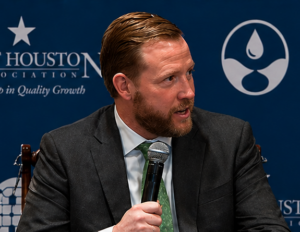 What emerged from the discussion was a clear shift in how sustainability is being understood. It is no longer framed as an added feature or a “nice to have,” but as a practical approach that aligns environmental performance with financial outcomes. As Sustainable Infrastructure Committee Chair and forum moderator Harry Thompson put it early in the conversation, “The goal here is not just to help the environment… we’re also talking about the bottom line: how to save money, how to have efficient implementation, and how to do really cool stuff.”
That framing carried throughout the discussion. Panelists consistently emphasized that sustainable infrastructure is not about being green for its own sake. It is about delivering projects that perform better, last longer, and create value over time.
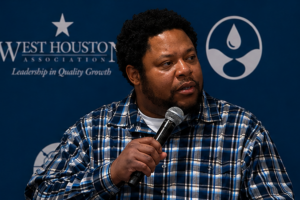 From the public sector perspective, sustainability is closely tied to water quality and flood resilience. Harris County continues to prioritize systems that improve both, recognizing that long-term performance is critical in a region prone to flooding. “For me, sustainability is what I do every day,” said Donald Thompson of Harris County Engineering. “It improves water quality, reduces flooding, and does everything we’re trying to achieve.”
Low Impact Development, or LID, is central to that effort. By managing stormwater closer to where it falls and slowing its movement through a site, these systems reduce strain on downstream infrastructure while improving overall outcomes. Just as importantly, they are increasingly supported by policy. Harris County’s LID program offers incentives such as reduced detention requirements, creating opportunities for developers to use land more efficiently. In one example shared during the discussion, a project that would have required a large detention pond was able to incorporate LID strategies, ultimately freeing up space for additional buildings and improving the project’s financial return.
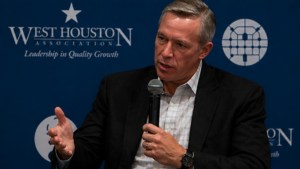 For developers, particularly those working at scale, sustainability is inseparable from long-term planning. Master-planned communities are built over decades, not years, and must remain viable across changing market conditions. “We’re in these communities for generations,” said Jim Carman of Howard Hughes. “The projects we deliver need to be sustainable over time, not just environmentally, but in how they function and remain viable.”
That long-term perspective shapes decisions that go beyond traditional infrastructure. In communities like Bridgeland and The Woodlands, significant portions of land are dedicated to open space, trails, and water features. These elements serve multiple purposes, supporting stormwater management while also enhancing quality of life. During the pandemic, when demand for outdoor space increased dramatically, these features proved to be not just desirable, but essential.
While the long-term vision is important, the discussion repeatedly returned to the immediate financial realities of development. The question is not whether sustainable infrastructure is beneficial in theory, but whether it works in practice. The examples shared suggest that it does.
 Matthew Smith of Greenrise Technology pointed to multiple projects where LID strategies resulted in significant cost savings. In some cases, developments were able to avoid expensive underground detention systems entirely. In others, reducing detention requirements allowed for additional buildings or increased density, fundamentally improving project feasibility. “If it doesn’t pencil, it doesn’t work,” Smith said. “But what we’re seeing is that in many cases, it does pencil.”
These are not marginal improvements. They are changes that can determine whether a project moves forward at all. In one case, a development that initially could not meet financing thresholds was able to proceed after incorporating sustainable infrastructure, ultimately increasing both its scale and its return on investment.
Even with these benefits, adoption is often slowed by concerns about permitting, engineering complexity, and maintenance. The panel addressed each directly. On permitting, Harris County emphasized that LID projects can move through the process efficiently when there is early coordination. “There’s a lot of fear about delays,” Thompson said, “but that’s not the reality… with communication upfront, these projects can move through smoothly.”
Engineering presents a different challenge. Traditional drainage design focuses on moving water off-site as quickly as possible. LID reverses that approach, managing water within the site and slowing it down. This requires a shift in thinking, particularly for engineers accustomed to conventional methods. However, once that shift is made, the process becomes more predictable and repeatable.
Maintenance is another common concern, but one that is often misunderstood. As discussed during the panel, long-term maintenance costs are driven more by design decisions, particularly landscaping, than by the infrastructure itself. Native plantings, for example, can reduce water use and maintenance over time. Public perception can also play a role. In one example shared, a native planting area was initially criticized for looking unkempt, but once a simple sign explained its purpose, it quickly became appreciated.
Beyond the financial and technical considerations, the discussion also touched on benefits that are harder to quantify. “There are things you can’t measure in a spreadsheet,” Carman noted. Access to green space, walkability, and community design all influence how people experience a place and whether they choose to invest in it, either as residents or businesses. These factors may not appear directly in a pro forma, but they are critical to long-term success.
There are also broader regional impacts. Sustainable infrastructure can reduce flooding, improve water quality, and create more resilient systems overall. In some cases, developers have even received direct feedback from residents recognizing these benefits, a rare but telling indication of how these approaches can shape community perception.

Looking ahead, panelists pointed to opportunities to expand the use of sustainable infrastructure even further. While bioswales and permeable pavements are becoming more common, other strategies such as rainwater harvesting, rain gardens, and water reuse systems remain underutilized. At the same time, evolving policies, including recent updates to the City of Houston’s Infrastructure Design Manual and new tax abatement programs, are creating additional incentives for adoption.
What becomes clear through all of this is that sustainable infrastructure is no longer operating at the margins. It is becoming a central part of how projects are conceived and delivered. For a region like West Houston, where growth continues at a rapid pace, that shift is particularly important.
The decisions being made today will shape the region for decades. Aligning those decisions with approaches that improve performance, reduce costs, and enhance resilience is not just a policy goal. It is a practical necessity.
As Thompson summarized toward the close of the discussion, the opportunity is straightforward. “Y’all can do something cool while making money.”