
 Our 2026 QPD Symposium opened with a timely conversation on one of the most important challenges facing the Houston region: how to continue delivering high-quality communities while making new homeownership more attainable.
Following opening remarks from QPD Committee Chair Brian Gates, who framed quality planned development as the early coordination of infrastructure, land use, drainage, mobility, parks, amenities, housing, and long-term operations, Trey Reichert of Johnson Development set the stage for the day’s conversations. His presentation focused on attainable new housing ownership and the market realities shaping what can be delivered across Greater West Houston and the surrounding growth corridors.
Trey began by acknowledging that attainable housing is a challenge even for regions like Houston, which has long been known for relative affordability compared to other major metropolitan areas. While Houston continues to benefit from steady job growth, strong demand, and continued in-migration, those same strengths also create pressure. In Trey’s words, Houston’s challenge is not simply an affordability problem, but a “success problem.” People want to live here, companies continue to invest here, and families continue to grow here. The question is how the region can respond to that demand in a way that preserves quality while expanding opportunity.
Several common themes emerged from the housing market outlook Trey shared: affordability pressures persist, builders are facing margin compression, buyers remain sensitive to cost, and the market is recalibrating after several years of rapid increases. At the same time, Houston’s economic foundation remains strong. That combination creates a difficult but important planning environment. The region must continue adding housing supply, but it must do so thoughtfully.
Trey also emphasized Houston’s competitive advantages. The region still benefits from a relatively flexible land-use environment, the ability to deliver large-scale master-planned communities, available land in regional growth corridors, as well as the opportunity to provide a broader range of housing product types. Those advantages matter, but they must be used intentionally.
A central point of the presentation was that attainability does not mean lowering quality. Instead, it means delivering efficient design, lifestyle flexibility, and ownership opportunity. Smaller lot products, diverse housing types, smarter community design, and geographic expansion can all play a role. Trey pointed to townhomes, alley-loaded homes, attached products, build-to-rent communities, and other creative approaches as tools that can help more households access well-planned communities.
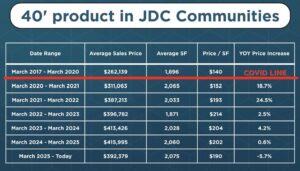 The data Trey shared on 40-foot products in Johnson Development communities illustrated the challenge clearly. What was once among the most attainable new-home products in a master-planned community has become significantly more expensive since COVID, with average prices rising from the mid-$200,000s before the pandemic to around $400,000 in recent years. Even as prices have moderated, the broader cost stack of land, labor, materials, financing, and regulation continues to make attainability difficult.
Trey closed with a memorable reminder that housing opportunity is also connected to expectations, geography, and lifestyle. As the region grows, attainable homeownership will depend not only on home prices, but also on how communities are planned, where jobs are created, how infrastructure is coordinated, and whether residents can access quality places to live across the Houston region.
As the opening presentation for the 2026 QPD Symposium, Trey’s remarks helped establish the foundation for the broader event discussion: quality growth requires partnership, planning, and a willingness to adapt. For Greater West Houston, the path forward is not about choosing between quality and attainability. It is about bringing the right people, tools, and planning frameworks together early enough to deliver both.