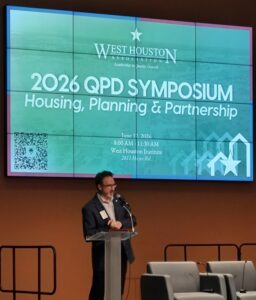
 At our 2026 Quality Planned Development Symposium, the first panel focused on a question that sits at the center of nearly every major development conversation in the Houston region: how can communities deliver attainable housing while still maintaining the elements that make a neighborhood feel complete, connected, and built for long-term value?
Moderated by Christopher Browne of EHRA Engineering, the panel used Baytown Crossings as a real-world case study. The conversation featured Becky Ullman, Director of Forward Planning for Friendswood Development Company, and Nathan Dietrich, who at the time of the project was Assistant Director of Planning for the City of Baytown. Together, they explored how a developer and a municipality worked through land planning, infrastructure, financing, development standards, lot-size flexibility, and community design to bring a quality master-planned community to a market that needed more housing choices.
Browne opened the discussion by noting that one of the first questions a developer asks when evaluating land is: “What jurisdiction am I working in?” For developers, the physical location of a property is only part of the equation. Jurisdictional requirements, utility availability, transportation access, lot-size standards, public finance tools, and the willingness of local government to engage as a partner can all shape whether a project is feasible.
 Baytown Crossings, recognized by WHA as a Quality Planned Development in 2024, offered a useful example of how those pieces can come together. Developed by Friendswood Development Company, the community was recognized because it delivers many of the elements associated with high-quality master-planned development, including trail connectivity, landscaping, recreation, open space, thoughtful amenities, and durable community design, while still addressing an entry- to mid-market price point.
For Friendswood, the appeal of Baytown was clear. As Ullman explained, Baytown had jobs, particularly in and around the industrial, petrochemical, Port of Houston, and Ship Channel economy. That employment base created demand for quality housing options. However, building a broad-based community at attainable price points required a close working relationship with the city.
From the city’s perspective, Dietrich explained that Baytown needed new development within and near its core. The city was interested in attracting new residents, expanding housing options, and supporting a better mix of residential choices. At the same time, the proposal from Friendswood differed from what the city’s existing development rules allowed. That meant the project could not move forward through a standard process alone. It required discussion, education, and a framework that protected the city’s interests while allowing the developer enough flexibility to create a viable community.
One of the central issues was lot size. Baytown had a 50-foot minimum lot standard, which, from the developer’s perspective, could have produced a more monotonous community and limited the range of price points that could be served. The final approach allowed for a broader mix of lot sizes, including 40-, 50-, 60-, 70-, and some larger lots across different sections of the community. Rather than simply producing a uniform subdivision, the varied lot mix helped support attainability, market responsiveness, and a more interesting community form.

 The panel also discussed the public finance and governance tools that made the project possible. Baytown had strong concerns about in-city municipal utility districts because of the potential for residents to feel they were subject to overlapping tax burdens. The solution involved limited purpose annexation and the creation of MUDs structured in a way that avoided full city taxation while still helping reimburse major drainage and roadway improvements. In addition, the project included a strategic partnership agreement, a development agreement, and a utility agreement.
Ullman noted that the structure of the agreements created a more balanced arrangement. Residents would not be subject to the full city tax while the city would provide water and sewer service. The developer paid traditional water and sewer impact fees, along with an additional premium, and also made off-site water and sanitary sewer improvements. Importantly, those improvements were designed not only to serve the development itself, but to provide capacity “to and through” the community so that future growth around Baytown Crossings could also benefit.
That approach reflects the type of public-private coordination WHA often emphasizes. Quality growth is not only about what happens inside the boundaries of one project. It is also about whether infrastructure is planned in a way that supports future connections, future service needs, and long-term regional value.
The land plan for Baytown Crossings also demonstrated how attainability and quality design can work together. Ullman described how the community used ponds, drainage features, and open space as amenities. Rather than concentrating open space in individual backyards, the plan used smaller lots in some areas to create more meaningful public open space, trail systems, pocket parks, amenity lakes, and recreational areas that could be enjoyed by the broader community.
Dietrich emphasized connectivity as one of the city’s priorities. Sidewalks, trails, and walkability were key parts of the discussion, including along major frontages such as Garth Road. The community also included a school site, reinforcing the importance of allowing children and families to move safely through the neighborhood. For Dietrich, seeing a wide variety of residents using the trails, including families, children, and older adults, showed that the community was functioning as intended.
Another major takeaway was the importance of predictability and flexibility. Development agreements are often thought of as legal or financial documents, but in this case they also created the structure needed for long-term trust. Ullman noted that market conditions change, and developers need the ability to respond. The agreements provided enough flexibility to adapt while still giving the city confidence in the quality and character of what would be built.
 Dietrich added that because the expectations were established early, the process remained relatively smooth as the project moved forward. After Hurricane Harvey, drainage was understandably a major concern, and continued communication between the developer, the city, and engineering teams helped maintain confidence in the project.
The panel ultimately showed that public-private partnerships work best when both sides are clear about their needs, honest about their constraints, and willing to build a framework that can withstand changing conditions. For the public sector, that means protecting standards, infrastructure capacity, and long-term community value. For the private sector, it means securing enough predictability to invest, plan, and deliver a project that meets the market.
Baytown Crossings is not just an example of a successful development. It is an example of how attainable housing, infrastructure planning, quality amenities, and municipal partnership can reinforce one another. As growth continues across the Houston region, the lesson is clear: communities do not have to choose between attainability and quality. With the right tools, the right conversations, and the right partners at the table, they can pursue both.