
At our 2026 QPD Symposium, the second panel focused on one of the Houston region’s most important growth questions: how can communities provide more attainable housing options while preserving quality, long-term value, and the character that makes master-planned communities successful?
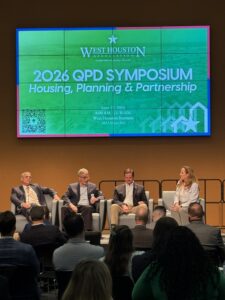 Moderated by Katie Sherborne with Allen Boone Humphries Robinson, the discussion brought together perspectives from development, homebuilding, and local government. Panelists included Matt Lawson with Rise Communities, Mark Welch with David Weekley Homes, and Byron Hebert with the City of Katy. Together, they explored how housing diversity, thoughtful amenities, infrastructure costs, municipal flexibility, and public-private trust all shape the future of quality planned development.
 Sherborne opened the panel by noting that conversations about housing attainability often begin with cost. In a region like Houston, where housing affordability has long been a competitive advantage, rising costs are changing the equation for families, young professionals, retirees, and the communities trying to serve them. However, the panel emphasized that attainability should not be understood as simply building cheaper homes or reducing quality. Instead, it requires matching housing supply to a wider range of needs, life stages, and price points while maintaining the standards that create lasting community value.
One of the central themes of the conversation was the evolution of housing diversity in suburban Houston. As Sherborne noted, there was a time when “housing diversity” often meant whether a community would allow 55-foot lots instead of the traditional 60-foot lots. Today, that conversation has expanded dramatically. Smaller lots, alley-loaded homes, zero-lot-line products, build-to-rent communities, and higher-density detached housing are all part of the broader discussion about how to create communities that can serve more people.
Lawson reflected on the early challenges of bringing new housing concepts to the City of Katy through Cane Island, recognized by WHA as a Quality Planned Development in 2024. Coming from Las Vegas, he encountered skepticism about whether smaller lots and different product types could meet Katy’s expectations for quality. He recalled that building trust took time, repeated conversations, and the ability to show that quality was not limited to larger lots. He emphasized that quality can happen at every level when the development is thoughtfully planned, well-executed, and supported by strong builders.
Hebert provided the local government perspective, describing how city leaders had to decide whether to resist change or engage with it in a way that gave the city a role in shaping outcomes. His message was practical: growth was coming either way, and the better choice was to help guide it. By working with developers and builders willing to deliver quality, the City of Katy was able to support new housing products while protecting the long-term interests of the community.
Welch discussed how builders evaluate housing diversity from the market side. David Weekley Homes has worked with developers to introduce different lot sizes and product types in communities such as Bridgeland, including alley-loaded homes, 35-foot lots, and compact detached products. He noted that these homes can serve buyers who want access to high-quality amenities and strong community design but may not need, want, or be able to afford a larger traditional suburban lot.

The panelists agreed that smaller lots do not necessarily mean lower quality. In many cases, they reflect changing demographics, changing household sizes, and changing preferences. Some buyers may be young professionals purchasing their first home. Others may be empty nesters who want less maintenance. Some may be families who value access to parks, trails, schools, retail, and community amenities more than a large private yard. The key is providing choices within a well-planned community framework.
Amenities emerged as another major part of the attainability discussion. Lawson explained that in highly amenitized master-planned communities, shared parks, trails, pools, and open spaces help support a broader range of home types. Not every resident needs a large backyard if the community provides meaningful public and shared spaces. He also emphasized that vibrant communities depend on a mix of ages and life stages, from young adults and families to retirees. That diversity creates energy, connection, and long-term community strength.
Infrastructure costs were also a significant part of the conversation. Sherborne asked how impact fees and capital recovery costs affect the ability to deliver quality housing diversity. Hebert explained that keeping costs reasonable has been part of Katy’s ability to attract quality developers and support quality projects. When costs are too high, they can affect the economics of development and ultimately raise home prices.
Welch reinforced that point from the builder’s perspective. Higher fees do not simply add a fixed cost to a home; they can also change the type of home that must be built in order for the project to work financially. As costs rise, builders may need to deliver more expensive homes, which can price more buyers out of the market. In that way, infrastructure cost decisions directly influence housing choice, market velocity, and attainability.
The panel also touched on the role of trails and connectivity. Hebert highlighted Katy’s Snow Goose Trail project, which is intended to connect neighborhoods, parks, and the city’s downtown area. This type of investment reflects a broader understanding of quality development: housing is not just about the home itself, but about how residents move through and experience their community. Trails, walkability, open space, and access to destinations all contribute to quality of life. 
Build-to-rent housing generated a more nuanced discussion. Sherborne noted that while some communities have concerns about rental housing, build-to-rent can serve residents who want the space and feel of a single-family home but may not yet have the down payment needed to purchase. Lawson described build-to-rent as one response to the larger affordability challenge, but stressed that it should be treated as a niche and thoughtfully integrated with its own amenities and quality controls. Welch added that professionally maintained rental communities can meet a real market need, particularly for families with pets, children, or a desire for a yard. Hebert, however, made clear that the City of Katy is not currently looking to pursue that product type, demonstrating that different communities may approach housing diversity in different ways.
Looking ahead, the panelists expected continued movement toward smaller lots, more density, and greater product diversity. Rising land prices, changing buyer needs, and the desire for more attainable options will continue to push the market in that direction. At the same time, the panel made clear that density alone is not the answer. Success depends on design, amenities, infrastructure planning, builder quality, and a willingness among public officials and private partners to listen to one another.
For WHA members, the discussion underscored a familiar but important point: quality growth requires coordination. Housing attainability, community character, infrastructure investment, and long-term value are deeply connected. When developers, builders, cities, MUDs, and other partners work together early and thoughtfully, communities can provide more choices without sacrificing quality.
The future of Greater West Houston will require exactly that kind of collaboration. As growth pressures continue, the region’s opportunity is not simply to build more, but to build better, with communities that are attainable, resilient, connected, and prepared to serve residents across every stage of life.