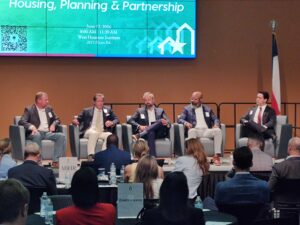
The third panel at our 2026 QPD Symposium shifted the conversation from housing diversity and attainability to the broader question of preparedness. As Greater West Houston continues to grow, the issue is no longer whether growth will come, but whether communities, infrastructure systems, and development partners will be ready to manage it well.
Moderated by Loren Morales of Rathmann & Associates, the panel brought together perspectives from market research, development, retail, and county government. Panelists included Danny Ware with CBAS, Shaun Smith with NewQuest, Harry Masterson of Ember, and Waller County Commissioner Justin Beckendorff. Together, they explored the tools, partnerships, and lessons needed to respond to accelerating housing demand while maintaining quality development and long-term community value.
 The panel opened with a big-picture discussion of Houston’s continued population growth. Ware noted that the region has added roughly 1.3 million people since 2015, reinforcing that demand is not hypothetical. Growth is already happening, and the development community must be prepared to respond. He emphasized that the more tools developers and builders have available, the better they can meet demand with a diverse housing supply and more thoughtful community planning.
For counties experiencing rapid growth, that challenge can be especially intense. Commissioner Beckendorff described how Waller County’s projections have been dramatically outpaced by reality. When he first entered office in 2015, the county was projected to reach 80,000 residents by 2050. Instead, he said Waller County is on track to reach that number by the end of this year. That kind of growth creates immediate pressure on roads, county facilities, public safety, and other services that residents may not see on the front end but expect to function when new homes are built.
Beckendorff also highlighted the challenge of infrastructure that does not grow neatly or sequentially. Development does not always “stack” in a predictable pattern. Instead, it can appear in scattered locations, creating a “bingo card” effect that makes it more difficult to plan and prioritize infrastructure investments. A two-lane county road designed for a few hundred vehicles a day can suddenly face thousands of trips as new residents move into nearby communities. That reality makes mobility planning, updated road studies, and regional coordination essential.
Masterson, speaking from the developer perspective, acknowledged that it is difficult for public entities to stay ahead of growth. New homes and residents often arrive before schools, roads, and services can fully catch up. He pointed to school districts as one example, noting that districts must project enrollment, reach critical mass, and make major capital decisions before new campuses can be justified and built. For developers, that means being at the table early, sharing information about what is coming, and working with local officials rather than expecting government to solve every problem alone.
 Smith brought the retail and commercial perspective into the discussion, explaining that retail often serves as a form of demand confirmation. By the time a grocery-anchored center or major commercial project is underwritten, much of the hard work around housing, infrastructure, utilities, and community formation has already occurred. Retail developers look for signs that a community is prepared for growth, including road bonds, mobility improvements, MUD formations, utility planning, and strong rooftop velocity. When thousands of homes are coming, those rooftops become future customers, employees, and the basis for long-term commercial investment.
The panel also explored what happens when growth arrives before a community is ready. Ware pointed to traffic as one of the clearest indicators. Sometimes road needs change faster than anticipated because a development sells more quickly than expected, or because broader market conditions accelerate demand. Beckendorff noted that even when counties know growth is coming, public funding does not arrive upfront. A development may generate future tax base, but counties must often build facilities before those revenues fully materialize. That creates a constant challenge of catching up while trying to plan ahead.
Several panelists emphasized the importance of data. Ware discussed the value of tracking communities, subdivision sections, housing growth, and market trends at a granular level. Market studies, MUD studies, and active project tracking can help developers, builders, and public officials better understand where growth is headed. While data does not eliminate uncertainty, it can help decision-makers avoid being surprised and support more informed planning.
Housing diversity remained a central theme throughout the panel. Ware explained that a diverse housing supply gives developers more “levers” to respond to different market needs. When counties or municipalities remove those options, they can unintentionally limit the ability of experienced builders and developers to meet demand. Masterson added that diversity of product improves a community by serving people at different life stages and avoiding a repetitive landscape of the same home type repeated thousands of times. Different lot sizes, home types, and price points help communities appeal to young families, empty nesters, first-time buyers, and others seeking a quality place to live.
Smith expanded the attainability conversation beyond the price of the home itself. He noted that the location of retail, services, childcare, grocery stores, restaurants, and employment opportunities affects the real cost of living. A home may appear attainable on paper, but if residents must drive 30 or 45 minutes for daily needs, transportation and time costs reduce that attainability. From a retail perspective, housing diversity and commercial access must be considered together to create complete communities that support a practical and sustainable lifestyle.
Rising costs were another major topic. Masterson noted that land prices and home prices rarely go down; they tend to hold or continue rising. That creates pressure to explore smaller lots, new financing tools, and more efficient infrastructure strategies. Beckendorff described similar cost escalation on the public side. Road construction, county facilities, and major infrastructure projects have all become more expensive since COVID, making it even more important to act early where possible. As he put it, infrastructure is unlikely to be cheaper tomorrow than it is today.
 The panelists repeatedly returned to collaboration as the most important tool for managing growth. Beckendorff described the need for counties, cities, developers, and neighboring jurisdictions to coordinate road alignments, mobility plans, drainage, and public-private partnerships. Growth does not stop at city limits or county lines, and neither do traffic or water. That makes regional communication critical.
Masterson emphasized MUDs as one of the region’s most effective tools for bringing private investment into public infrastructure. In his view, municipal utility districts have helped make the Houston region’s growth model work by allowing major infrastructure costs to be financed over time rather than loaded entirely onto the front end of development.
Smith closed the panel discussion with a concrete example: Texas Heritage Marketplace. He described the project as a major retail investment made possible through collaboration with Waller County and the City of Katy. The development will bring significant retail services to an area that needed more commercial options, including major anchors and restaurants. Importantly, he noted that the project depends on a diverse surrounding housing base. A trade area made up only of large, high-end lots would not support the same scale of retail.
The third panel reinforced one of the symposium’s central messages: quality growth does not happen by accident. It requires data, planning tools, infrastructure investment, housing diversity, commercial strategy, and strong public-private partnerships. For Greater West Houston, the path forward will depend on the region’s ability to stay coordinated, remain flexible, and plan for growth before it arrives at the doorstep.
As the region continues to expand, WHA’s work remains focused on bringing these conversations together. Developers, builders, engineers, public officials, school districts, counties, cities, MUDs, and commercial partners all have a role to play. The communities that succeed will be those that do more than react to growth. They will prepare for it, shape it, and build the infrastructure and partnerships needed to support a stronger future.