Meeting the water needs of a growing region will require both new supplies and more efficient use of the water already available. At its USA headquarters in Brookshire, Texas, Grundfos offers a practical example. The facility meets approximately 87% of its non-potable water demand without municipal water by collecting rainwater from its roof and drainage system, treating it onsite, and reusing it for irrigation and cooling-related purposes.
In 2024, WHA recognized the project through its Sustainability Stars program. Grundfos received all five stars—Investigation, Investment, Integration, Innovation, and Inspiration—for features that include rainwater and greywater reuse, reduced irrigation needs, heat-island mitigation, solar energy, natural lighting, and energy-efficient equipment.

The water reuse process begins when rainwater from the roof and drainage system flows into storage tanks. It then passes through filtration and Grundfos’ AQPure treatment system before entering a treated-water tank. Automated pumps distribute the water for non-potable uses, while continuous monitoring helps facility operators manage the system. The accompanying diagram illustrates the collection, filtration, treatment, storage, and distribution process used at the Brookshire facility.
By treating and reusing water onsite, Grundfos reduces demand on municipal infrastructure and may lower its utility costs. The system also provides the facility with another water source during drought conditions or water restrictions.
The irrigation strategy is designed to reduce long-term demand. Treated rainwater supports newly planted landscaping during its first two years, when supplemental water helps establish strong root systems. Once the plants are established, irrigation is reduced or discontinued so the landscape can rely primarily on rainfall.
Water efficiency extends beyond irrigation. Grundfos uses monitoring, high-efficiency pumps, leak detection, preventive maintenance, and automated controls to manage cooling-system water use. Low-flow faucets, efficient restroom fixtures, sensor-operated devices, aerators, and flow restrictors further reduce demand throughout the building.
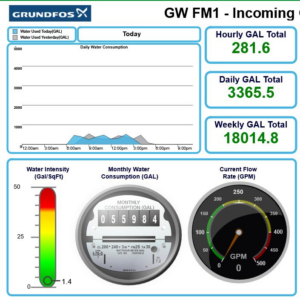
The approach also has relevance for data centers, where cooling can account for a significant share of onsite water demand. Rainwater harvesting, optimized cooling-tower controls, smart monitoring, and efficient fixtures could help reduce potable water use. Data center operators could also evaluate the recovery of condensate from HVAC systems. The right combination will depend on each facility’s design, cooling requirements, and local water conditions.
For WHA, the Grundfos project is a useful example of sustainable infrastructure in practice. It pairs water conservation with reliable facility operations and offers ideas that other industrial and commercial developments can adapt as Greater West Houston continues to grow.